Crypto casino network fees and what a casino adds on top
Two different parties can take something from a crypto transfer: the blockchain that carries it and the casino that sends it. Only one of them has to be written in the terms.
Plinko casino fees come from two directions, and mixing them up is how people end up blaming the wrong party for a smaller payout. The blockchain charges for moving coins; the casino may add its own charge only where its terms allow it. A third cost, the minimum withdrawal, is not called a fee at all but behaves like one for small balances.
Crypto casino network fees: who actually gets them
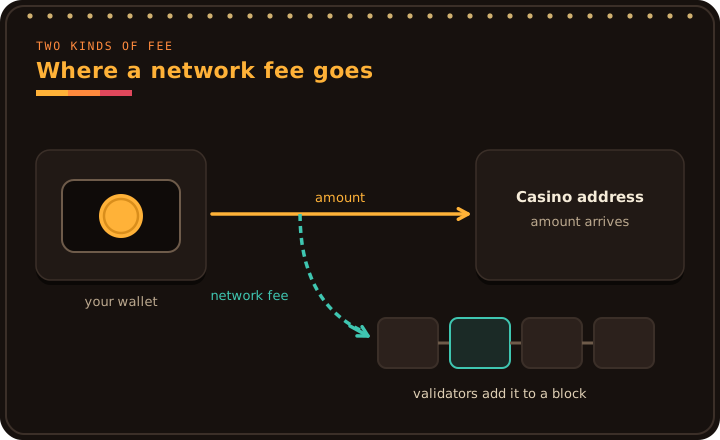
A network fee pays the miners or validators who put a transaction into a block. It is not revenue for the casino, and the casino cannot waive it on the chain's behalf. How big it is depends on the coin, the network and how busy that network is at the moment.
Crypto casino network fees show up at both ends of a session:
On a deposit, your wallet pays the fee when you send. The casino receives whatever arrives after it.
On a withdrawal, the casino's wallet sends the coins, and the network fee for that transaction is paid from somewhere: either the operator absorbs it, or the terms say it comes out of your amount.
Because the fee is set per transaction rather than per dollar, it weighs far more on a small transfer than on a large one.
Picking the cheaper route
Where the cashier offers a coin on more than one network, the fee usually differs between them. That choice is yours on deposit, and sometimes on withdrawal too. Match the network exactly on both sides; the cashier walk-through shows what to check before sending.
Plinko casino fees an operator may add
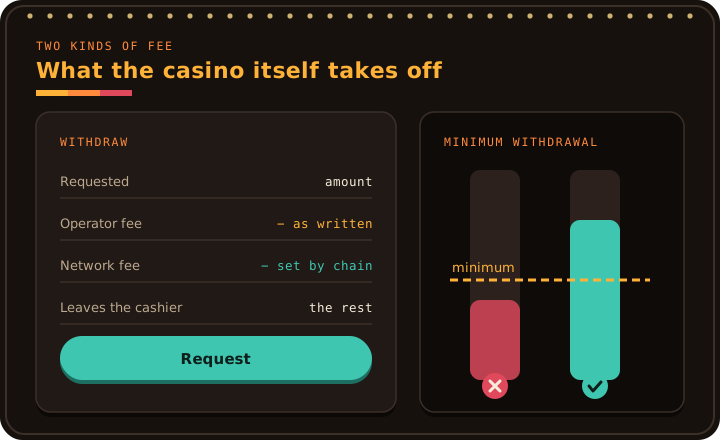
An operator fee is different: it is money the casino keeps or passes on under its own rules. It is only legitimate when the terms print it. Look for these lines in the payment or withdrawal section:
The network fee never reaches the casino. It is paid to whoever records the transaction on the chain, and it is set by the network, not by any operator’s terms.
A withdrawal fee, flat or as a share of the amount.
A line saying network costs are deducted from the sum you request.
A charge on unplayed deposits, where the terms treat a deposit withdrawn without play as a special case.
A conversion margin, if the casino changes one coin into another for you.
If none of these appear, a deduction you did not expect is a question for support, in writing, with the clause (or its absence) quoted.
Wagering is not a fee, but it costs time
Some terms stop a withdrawal until a deposit has been played through. Vave's cl. 8.11 asks for three rounds of turnover on casino or live games, or one on sports, first. No coins are taken, but the balance is exposed to the house edge while you meet the line.
Minimums as a practical fee
A minimum is the fee nobody calls a fee. If your balance sits below it, the money stays in the account until you add more or play it away.
Rainbet prints a US$15 minimum in cl. 8.1.
Bitcasino.io sets a minimum deposit for each coin, and under cl. 5 a deposit below it is void, so a small top-up can be lost before it counts.
Rocketpot sets its deposit minimum at 0.001 BTC in cl. 10.2.
The numbers here are hypothetical and chosen to be easy to follow; real fees change from hour to hour.
Separate from the network fee: what the operator’s own cashier deducts, and the minimum below which it will not send anything. Both sit in the operator’s terms, if they are written down at all.
Say you deposit US$40 in a stablecoin and your wallet pays US$1 in network fee, so US$39 arrives. You play a few Plinko rounds and finish at US$30. You request the full US$30. In this example the casino's terms say network costs come out of the withdrawal, and the network fee at that moment is US$1.50.
You receive US$28.50.
The total spent on moving money is US$2.50, or about 6% of the original US$40.
Had the balance ended at US$14, it would sit under a US$15 minimum like Rainbet's, and nothing could leave until it grew.
The lesson is not that fees are high, but that they are fixed-ish per transfer. Fewer, larger transfers lose a smaller share.
When the numbers do not add up
A payout that arrives short is usually one of three things, and each has its own place to look.
The network took its cut. Open the transaction in a block explorer: the fee is shown next to the amount. If the difference matches it, crypto casino network fees explain the gap and the casino is not involved.
The terms deduct something. Compare the gap with the fee lines in the payment section. A printed withdrawal fee or a deducted network cost will match the numbers.
Neither matches. Then write to support with the transaction hash, the amount requested, the amount received and the clause you read. Keep the tone factual and keep copies.
A converted balance adds one more layer: if the casino swapped coins for you, the rate it used belongs in the same message.
Keeping a simple log helps here. Note each deposit and withdrawal with its coin, network, amount sent and amount received. After a few sessions the pattern is obvious, and so is any charge that does not belong.
Checking plinko casino fees before you deposit
Search the terms for “fee”, “charge”, “deduct” and “network”.
Note the minimum deposit per coin and the minimum withdrawal.
See whether network costs on withdrawal are absorbed or deducted.
Look for a rule on withdrawing a deposit that was not played.
Compare the likely network fee with the size of transfers you plan to make.
For how the ranked casinos compare on the terms themselves, the card-by-card deck lists the clauses.
Frequently asked questions
Questions people actually type
Does the casino keep the network fee?
No. The network fee goes to whoever validates the transaction on that blockchain. A casino can decide whether to absorb that cost on withdrawals or pass it to you, and if it passes it on, its terms should say so. Any charge beyond the network's own cost is an operator fee and belongs in the terms too.
Why did a small withdrawal lose so much?
A blockchain prices each transfer on its own, whatever the sum inside it, so the same fee is a larger bite out of a small request. Add a minimum withdrawal on top, such as the US$15 line in Rainbet's cl. 8.1, and small balances become expensive to move. Fewer, larger withdrawals keep the share lower.