Plinko original games versus studio Plinko in a casino lobby
Two Plinko tiles in the same lobby can come from very different places: one built by the casino itself, one supplied by an outside studio. Here is how to tell them apart in a minute and why the difference matters before a deposit.
Scroll a crypto casino lobby and the Plinko tiles rarely look alike. Some plinko casino games are built by the casino itself and sit in a section called «Originals» or «In-house»; others are made by an outside studio and carry its name on the tile. Players searching for online plinko games tend to treat them as one product. They are not, and the difference decides where you look for the return figure, the seed panel and the limits.
Two kinds of plinko casino games
House originals
A house original is a Plinko the lobby shows without any outside studio's name. The casino, or a supplier it does not credit, runs the game on its own platform. Plinko original games usually share a look with the casino's other in-house titles — dice, mines, limbo — and often come with a seed panel built into the same interface.
Studio titles
A studio title is a Plinko made by a game studio and offered in many casinos at once. The tile, the loading screen or the rules panel names the studio. Its paytable, return figure and settings are set by the studio, and the studio's own page for the game is a second place to read them.
Both kinds can appear in one lobby, sometimes next to each other with similar artwork. Treat them as different games even when the names are close. That distinction between a house build and a studio build is exactly the line the plinko casino sites deck draws for each of its twelve entries.
How to tell them apart in a lobby
Three checks answer the question in almost every lobby.
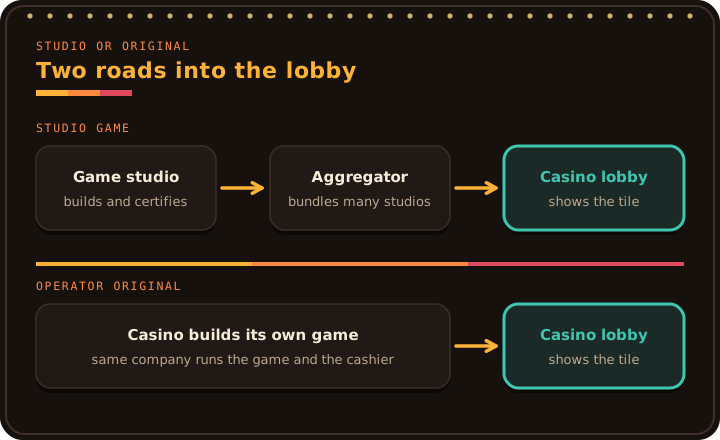
The same tile can arrive two ways. A studio game passes through an aggregator on its way to the lobby; an operator original is built and hosted by the casino itself, so its rules page belongs to the casino.
The tile credit. Hover or tap the tile. Studio titles usually show the studio's name under the game name; house originals show none, or the casino's own brand.
The game page. Open the game's page rather than the play button. A studio title names its provider there; a house original is filed under the casino's own section.
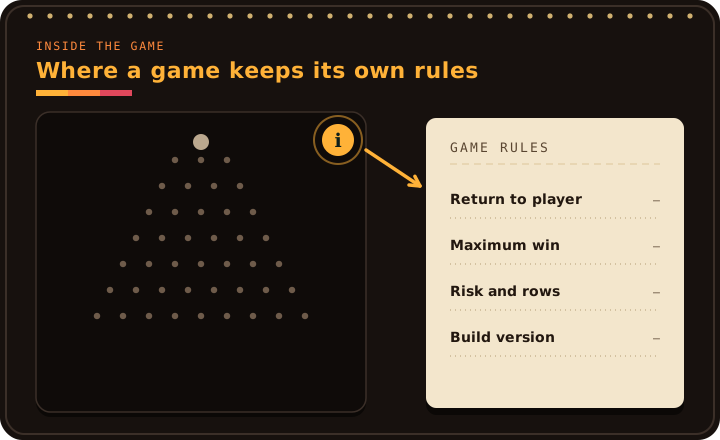
The rules panel. Inside the game, the info icon usually opens rules that name the studio and version. A house original's rules tend to point to the casino's fairness page instead.
If all three stay silent, filter the lobby by provider. A Plinko that appears under a studio's filter belongs to that studio; one that appears only under «Originals» is a house version.
What changes between a house original and a studio title
The return figure
For a studio title the figure comes from the studio, and its game page is where to confirm it. For plinko original games the casino prints it, usually in the rules panel or on a help page. Either way, if no figure is printed, treat it as unknown rather than borrowing one from a different Plinko.
Rows, risk and the top figure
Each studio chooses its own row range, risk options and paytables, and a house original has its own again. Two games called Plinko can therefore offer different boards and very different edge figures. The rows and risk guide explains what each control changes.
Seeds or a tested generator
Many house originals use a commit–reveal seed scheme you can check yourself. Studio titles vary: some expose seeds, others rely on a random number generator tested by an outside lab and show no seed panel. The rules panel says which model a game uses, and the one-drop seed check covers the first kind.
Limits
Studio titles carry the studio's stake range and any max-win line in their rules; a casino can narrow the range further. House originals follow the casino's own settings. In both cases the casino's terms still decide how a balance leaves the account.
Plinko casino games in twelve ranked lobbies
The matrix below records, for each numbered casino, the Plinko tiles its own lobby or game pages showed on 16 September 2026 and the studio each tile was credited to.
Casino
Spribe
House game
BGaming
SmartSoft
Hacksaw Gaming
TaDa Gaming
Bitcasino.io
Plinko
PLINKO
—
—
—
—
Rocketpot
—
Plinko
—
—
—
—
Sportsbet.io
—
PLINKO
Plinko
—
—
—
Winz.io
Plinko
PlinkoX
Plinko
—
—
—
Blockbet
—
Plinko
—
Plinko X Classic
—
—
Metaspins
Plinko
Plinko
—
—
—
—
Rainbet
—
Plinko
—
—
—
—
Shuffle.com
—
Plinko
—
—
Plinko
—
TG.Casino
—
PLINKO
Plinko
—
—
—
Winna
—
Plinko
—
—
—
—
Hyper Lucky
—
—
—
—
—
Plinko
Bitsler
—
Plinko
Plinko
—
Plinko
—
Which Plinko each lobby showed, sorted by the studio the lobby credits. "House game" means the casino lists no outside studio for it.
A studio name in a cell means the lobby credited the tile to that studio; a dash means no tile from that studio was recorded there that day. Lobbies change, so treat the matrix as a starting point and confirm on the casino's own site. Read casino by casino, the lobbies fall into three groups.
Inside the game, not in the casino’s terms: the information button opens the build’s own rules sheet. The values are blank here because they belong to a specific build, and the page beside this drawing names whose.
A house version only
Rainbet lists Plinko among its Rainbet Originals, next to Limbo, Mines, Dice and others.
Winna files its Plinko under Winna Originals.
Rocketpot shows one Plinko credited to «Exclusive games», with no studio named and a release date of 13 August 2025.
A studio title only
Hyper Lucky carries TaDa Gaming's Plinko.
Both side by side
Bitcasino.io has Spribe's Plinko on its Spribe provider page and a PLINKO in its Bitcasino Originals row. Its page for the Spribe title prints 96%, while Spribe's own page prints 97% — one more reason to read the panel of the tile you open.
Sportsbet.io puts a PLINKO in its originals row, whose game page says it has no fun mode, and also offers BGaming's Plinko.
Winz.io offers Spribe's Plinko with a free demo, BGaming's Plinko and a tile called PlinkoX with no studio credit on it.
Blockbet lists SmartSoft Gaming's Plinko X Classic, with its game page printing 97.00% RTP and a 3.00% house edge, plus a Plinko in its own originals.
Metaspins shows a Plinko tile labelled ORIGINALS alongside Spribe's.
Shuffle.com has Hacksaw Gaming's Plinko and a Plinko of its own among its originals.
TG.Casino carries BGaming's Plinko and a PLINKO tile without a studio credit.
Bitsler has the widest spread: its own Plinko, described on its page with 8 to 16 rows and Low to High risk levels, plus BGaming's and Hacksaw Gaming's.
Where a lobby holds two or three Plinko tiles, they are separate games with separate paytables. Opening the wrong one is an easy way to play a paytable you did not plan for, which is why online plinko games in the same lobby deserve a look one tile at a time.
Checking plinko casino games before you deposit
People who type «plinko game casino» into a search bar usually want one thing: a lobby where Plinko is actually playable. Whichever plinko game casino you land on, a lobby check takes a few minutes and saves a deposit into a casino whose Plinko is not the one you expected.
Search the lobby for «Plinko» and note every tile that appears, not just the first.
For each tile, find the studio credit or confirm it is a house version.
Open the rules panel and look for a return figure, the row range and the risk options.
Check whether a seed panel is present, or whether the rules describe a tested generator.
Look at the stake range and any max-win line.
Then leave the game and open the casino's terms: the identity clause, the withdrawal cap and any deposit wagering condition apply to every Plinko in that lobby, house or studio.
Demo mode
In a plinko game casino lobby, some tiles open in a free demo before sign-up; others need an account. A demo shows the board and paytable, which is enough for the checks above, but it does not show the account rules that apply once money is involved.
What stays the same across every Plinko tile
Whoever built the game, a few things hold everywhere.
The ball meets one peg per row, and a board with n rows ends in n + 1 slots.
Central slots are reached far more often than edge slots, and paytables price them accordingly.
A risk setting changes the paytable, never the ball's path.
The casino's own terms govern deposits, identity checks and withdrawals, regardless of the studio.
That last point is why, when comparing plinko casino games, the casino comes first. A generous-looking studio game in a lobby with a tight weekly cap and a short document deadline can be a worse fit than a plainer Plinko at a casino with clearer terms. The withdrawal caps page and the identity check guide cover those clauses.
Questions people actually type
Are plinko original games fairer than studio titles?
Not by definition. A house original often has a seed panel you can use to confirm a drop was not changed, while a studio title may rely on a lab-tested generator instead. Both are ways of showing a result was not altered. Neither says anything about how much the game returns over time, which you read from the rules panel or the studio's game page.
Why do two plinko casino games with the same name pay differently?
Because each studio, and each casino building a house version, sets its own paytables, row range and risk options. A title called Plinko in one lobby can have a different edge figure and centre figure from a title with the same name in the next lobby. Always read the strip and rules panel of the exact tile you opened.
Do casino terms apply the same way to every Plinko in a lobby?
Yes. The identity clause, withdrawal caps, instalment rules and deposit wagering conditions belong to the casino account, not to the game. A studio title and a house original in the same lobby are paid out under the same terms. Some terms also set how different game types count towards bonus wagering, so check that section if a bonus is active.