Plinko rows and risk: two dials, one ball, many paytables
The row control and the risk control sit side by side on every Plinko panel, and they do very different jobs. One changes the board, the other changes the price list, and neither gives the ball a kinder route.
Open a Plinko game in almost any casino lobby and two controls sit beside the stake field: a row count and a risk setting. Players tend to treat plinko risk levels and rows as one «difficulty» dial, but they rewrite different things. Rows change the board the ball falls through; risk swaps the paytable printed under it. This page takes each control in turn, then the combinations, then how to confirm what you have actually selected before the first drop.
The two controls on a Plinko panel
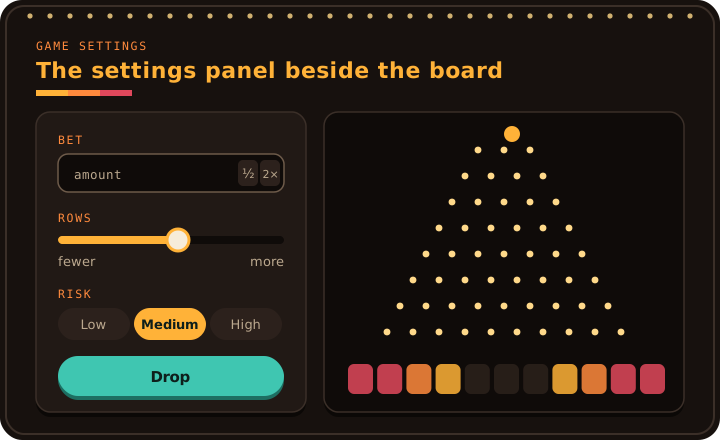
Rows — a number, usually offered as a range. It sets how many pegs the ball meets on the way down and how many slots wait at the bottom.
Risk — a small set of named options. It picks which paytable is loaded for the current board.
The ball's behaviour at each peg is the same under every setting: left or right, one turn per row. Everything else you see change on screen — the number of slots, the figures under them, their colours — comes from these two controls. Those same two controls sit behind every card in the plinko casino sites comparison, which reads each casino's licence and withdrawal cap next to its Plinko titles.
What the row count rewrites
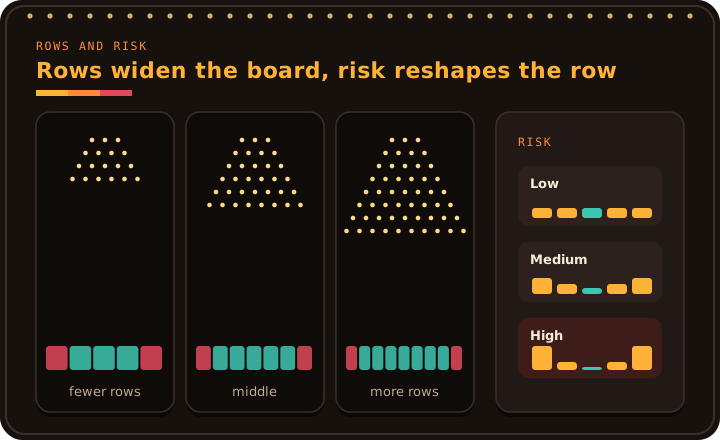
A board with n rows has n + 1 slots. Adding rows widens the floor and multiplies the number of routes a ball can take, while each edge slot keeps a single route.
The controls most Plinko builds share, drawn without any studio’s numbers. The bins are left blank on purpose: what they pay depends on the rows and risk you pick and on whose build it is.
The difference is large. On 8 rows the centre collects 70 of 256 routes and each edge collects one. On 16 rows the centre collects 12,870 of 65,536 and each edge still collects one. So a longer board makes edge landings far rarer, and its paytable prints a far larger edge figure to match. The edge slot explainer works through one session of drops on both boards.
What plinko risk levels rewrite
Risk does not touch the board. The same seeds, the same row count and the same drop would send the ball into the same slot under every risk option. What changes is the figure printed under that slot.
Moving to a higher option normally lifts the outer figures and pushes the central ones lower. Moving to a lower option flattens the strip: modest edges, a centre closer to the stake. Because the centre is where most drops land, a high-risk strip returns less on most drops and much more on the rare outer ones.
Same drop, two paytables — a made-up case
Imagine an 8-row drop that lands one step off the centre. On an invented low-risk strip that slot pays 1.1×; on an invented high-risk strip the same slot pays 0.3×. The ball did exactly the same thing both times. Only the price list differed.
Plinko rows and risk together
The two controls multiply each other's effect. It helps to picture the four corners of the panel.
Few rows, low risk. Frequent small returns close to the stake; the balance moves slowly.
Few rows, high risk. Edges arrive now and then with a moderate figure; the centre pays well under the stake.
Many rows, low risk. A wide floor, gentle figures, occasional landings further out with a noticeable but not dramatic figure.
Many rows, high risk. Long stretches of sub-stake landings and, very rarely, an edge figure many times larger than anything on the short board.
None of the four is cheaper over time where the game prints one return figure for all settings; they differ in how the same cost is spread across a session. The session budget guide turns that into stake sizes.
Plinko risk levels and rows as the studios print them
Studio sheets: the return, risk settings, row range and top multiplier each studio prints on its own Plinko page. A dash is a figure that page leaves out.
The sheets above hold only what each studio prints on its own game page, read on 16 September 2026. An empty field means the studio page gives no value for it, and it should not be filled from another game.
Two separate settings. More rows add bins and spread the landings; a higher risk setting moves value from the middle bins to the edges. Neither changes what the game keeps over time by itself.
BGaming, Plinko. Lines from 8 to 16 and three risk levels named high, normal and low. The page also prints a 99% RTP and a top multiplier of 1,000×.
Hacksaw Gaming, Plinko. Rows from 8 to 16 and risk set to low, medium or high. It lists seven RTP versions, from 98.98% to 88.20%, and a max win of 3,843.3×.
Spribe, Plinko. The page says the player can change the number of pins and with it the difficulty, and mentions three coloured buttons, but prints no names for the risk options and no row range. Its RTP is 97%.
Two things follow for a player. First, the names are not shared: «normal» on one board and «medium» on another are different studios' labels, and there is no reason to assume their paytables match. Second, the same «8 to 16» range on two tiles still hides different strips, so the figures on screen are what to compare, not the labels.
Plinko rows and risk on house versions
Casinos that build their own Plinko set their own panel. Some copy the familiar layout of 8 to 16 rows and three risk options; others offer a narrower range or different names. The casino, not a studio, prints the rules for a house version, usually in the game's info panel or on a help page. Read the controls there before assuming they behave like a studio title in the next tile. Bitsler is a clear case: its lobby carries its own Plinko, described on its page with 8 to 16 rows and Low to High risk levels, next to BGaming's and Hacksaw Gaming's versions, so one lobby offers three panels with three sets of labels.
Plinko risk levels in a casino lobby: confirming the setting
A few habits prevent the most common surprise — playing a setting you did not mean to pick.
Settings can carry over. Many games remember the last row and risk choice on that account, so a new session may start on last week's high-risk board.
The strip is the confirmation. Before the first drop, read the edge and centre figures. If they are not what you expected, the setting is not either.
Autoplay may lock the panel. Some games grey out the controls while autoplay runs; others allow changes mid-run. Stop autoplay before changing either control.
The history records the setting. Each drop in the round history shows the rows and risk it was played on, which is how you check a session afterwards.
House versions differ. A casino's own Plinko can offer a different row range or risk names from a studio title in the next tile. The house and studio Plinko guide shows how to tell which one you opened.
Choosing plinko rows and risk for a budget
Decide the session budget and the stake per drop first.
Count how many slots on the chosen strip pay under 1×. The more there are, the smaller the stake should be.
On high-risk, many-row settings, assume most of the budget goes on sub-stake landings and size the stake accordingly.
Read the top figure together with the casino's withdrawal cap and any max-win line; a huge edge figure means little if the terms pay it in portions. The caps by clause page shows where those lines sit.
Change one control at a time, and read the strip again after each change.
Questions people actually type
Do plinko risk levels change where the ball lands?
No. The risk option loads a different paytable for the same board, so an identical drop lands in the identical slot under every option and is simply paid a different figure. Only the row count changes the board itself. That is why a seed check recomputes the landing slot without needing to know the risk setting, while the payout does depend on it.
Are more rows better for big landings?
More rows raise the edge figure and make edge landings much rarer at the same time. On 8 rows either edge is 1 in 128 per drop; on 16 rows it is 1 in 32,768. Whether that trade suits you depends on your budget and patience, not on skill, because the setting does not alter what the game keeps over time.
Why does my Plinko game open on a setting I did not choose?
Many games remember the last row and risk selection on an account, and some casinos set their own default for a house version. Read the edge and centre figures on the strip before the first drop; if they look unfamiliar, check both controls. The round history also records the setting of every drop, so a session played on the wrong board is easy to spot afterwards.