Plinko casino countries: where the terms print the territory list
Every casino in the deck decides for itself which territories it will not serve. The list sits in its terms and on its sign-up form, and it binds the account, whatever a lobby or a search result suggests.
Plinko casino restricted countries are not set by the game or the studio that made it. They are set by the operator, in one clause of its terms, and repeated on its sign-up form. A Plinko tile in a lobby tells you nothing about whether an account in your territory is allowed; the clause does. This page shows where to find it and how to read it without guessing.
Where plinko casino restricted countries are written
Most terms keep the territory list in one of three places. Look in this order:
The account or eligibility section near the top of the terms, often next to the age line (18+).
A separate page linked from that section, sometimes titled as a list of excluded territories.
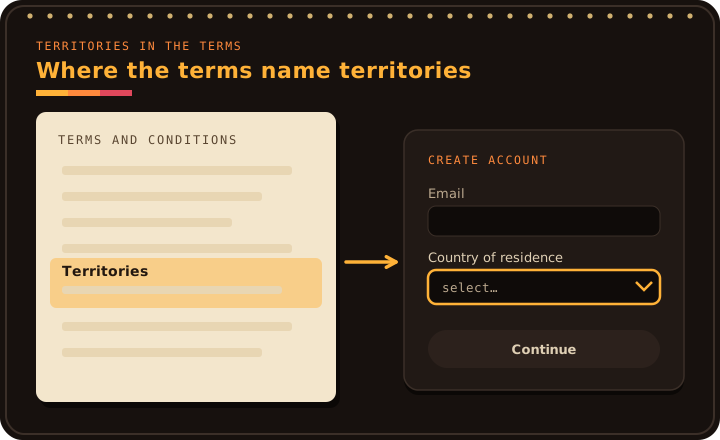
The sign-up form, where the country field may simply leave some entries out.
If the terms and the form disagree, the terms are the document you accepted. Save a copy of the page with its date at the moment you register, because the list can be edited later.
Search words that find the clause fast
Open the terms and use the page search for “restricted”, “territor”, “jurisdiction”, “excluded” and “residence”. One of them almost always lands on the right paragraph. Note the clause number next to the licence and ID clause numbers you already keep for that casino. The same clause numbers sit next to each other on the plinko casino sites cards, where the territory line joins the licence and identity clause for every casino.
Plinko casino countries: whose list is it?
The territory list belongs to the operator, and it applies to the account, not to a single game. Two consequences follow.
Two places carry the same list: a clause in the terms and the country field at sign-up. The terms are the document that counts when an account is reviewed.
One list per account. Plinko, slots, live tables and the sportsbook (if the casino has one) all sit under the same clause. A studio title does not carry a separate permission.
Different casinos, different lists. Twelve numbered cards in the deck means twelve separate clauses, and each operator writes its own. Reading one does not tell you about the next.
Many readers type “plinko casino countries” hoping for one master list. There is none that covers every lobby, and any list outside the terms is a copy that can already be out of date. The ranking cards give the clause numbers for ID checks and caps; the territory clause is worth adding to the same notes.
Long lists are code sheets
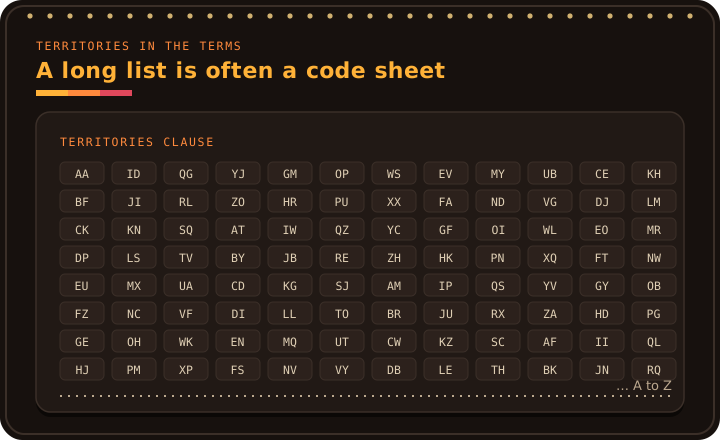
Some terms print a short paragraph. Others print a long run of names that looks like a whole atlas, including small islands and overseas dependencies. That second kind is usually a code sheet: a list lifted in bulk from a standard table of territory codes, not a considered choice made name by name.
Two practical rules follow from that.
Length is not a signal. A long list does not make a casino stricter in practice, and a short one does not make it looser. It shows how the page was built.
Absence is not an invitation. A territory missing from the list is not a promise that an account there is welcome. Look for a catch-all line after the names, the kind that lets the operator refuse or close an account at its discretion. Where it exists, it matters as much as the list.
Where plinko casinos accept players, according to the terms
The honest answer to “where plinko casinos accept players” is: wherever the operator's own clause does not exclude, and only as long as the rest of the terms are met. That includes the age line, the ID clause and, for some operators, a rule that the account holder's residence and the place of use match.
When a territories clause runs to dozens of entries in alphabetical order, it is usually an exported code table. Its length says little about any one country.
The ID check is where these meet. When a casino asks for documents, a proof of address shows the territory on the account; the page on document requests covers when that can happen. A residence that sits on the excluded list at that moment is a problem for the balance, not a detail.
So the practical sequence is simple:
Read the territory clause before depositing, not after a win.
Register with your real details, exactly as they appear on your documents.
If your territory is on the list, pick a different casino. Do not open the account.
Keep a note of the date you read the list; plinko casino countries lists get edited without much notice.
If the list is unclear, ask support in writing and keep the reply, but remember the terms still decide.
What the clause can mean for a balance
Territory clauses often sit next to lines about what happens to an account that should not have been opened: whether deposits are returned, whether winnings stand, whether the account is closed. Operators word this part very differently, so one casino's version is no guide to another's.
Look for these details:
Whether a balance is refunded, and in which coin.
Whether winnings are kept or cancelled.
Whether moving to a listed territory later affects an existing account.
If the clause is silent on these, ask. An answer in writing is better than a guess, even though the terms still take priority.
Travelling with an open account
A trip is the moment many players first meet this clause. Some terms tie eligibility to residence, others to the place the account is used from, and some mention both. Before logging in from somewhere new, reread the clause with that question in mind, and if the answer is unclear, wait until you are home rather than risking a balance on an interpretation.
A two-minute check on plinko casino restricted countries
Find the territory clause and note its number.
Open any linked list page and note its date.
Compare the list with the country field on the sign-up form.
Read the catch-all line at the end of the clause, if there is one.
Check the licence seal against the issuing authority's register; the licence walk-through shows how.
Only then look at the cashier and the Plinko titles in the lobby.
Gambling is for adults (18+). If it stops being entertainment, step away; Gamblers Anonymous holds meetings in many places.
Questions people actually type
Does a Plinko studio decide which territories can play its game?
The account side is decided by the casino. Its territory clause covers every game in the lobby, Plinko included, whichever studio made the title or whether it is a house version. Read the operator's terms; the studio's game page is the place for return figures and settings, not for account eligibility.
My territory is not on the list. Can I assume the account is fine?
No. Long lists are often bulk copies of a code table, and a clause may add a catch-all line that lets the operator refuse an account at its discretion. Read that line, check the sign-up form, and if anything is unclear ask support in writing before you deposit.
Can the list change after I register?
Yes. Terms carry a date and can be edited. Save a copy of the clause when you open the account, and re-read it before a large deposit or withdrawal. If the update affects your account, the new wording is what the casino will apply.