Plinko strategy at a casino: what settings change and what they never touch
Rows, risk and autoplay change how a Plinko session feels, not what the game keeps over time. The useful decisions are about stake size, stop points and the casino tools that hold you to them.
Every casino lobby with a Plinko tile attracts the same question: which setting gives the best chance? The honest plinko strategy starts one step earlier. Rows and risk reshape how a session swings, but no combination of them alters what the game keeps over a long run of drops. What you can control is how much goes in, how fast, and where you stop — and that is what this page is about.
What a plinko strategy can and cannot change
Think of a Plinko panel as two separate things. The board decides where the ball lands, and the paytable decides what each landing is worth. The row and risk controls swap the paytable and change the board size; they never give the ball a friendlier path. Rows and risk work the same way at every casino, which is why the plinko casino sites comparison scores the accounts behind them instead, licence, identity clause and withdrawal cap.
What moves when you touch those controls is the spread of results. A low-risk, short board returns small amounts often. A high-risk, long board returns very little on most drops and occasionally something large. What does not move is the long-run share the game keeps, known as the house edge, which is built into every paytable the studio ships.
One worked number
For example, BGaming prints a 99% RTP on its own Plinko page, which puts the house edge at 1%. Bet US$1 per drop for 200 drops and you have put US$200 through the game, so the long-run expectation is about US$198 back. Any single session can finish well above or well below that, and the setting you picked only decides how wide that range is.
Where the return figure sits in a casino
Before sizing any stake, find the figure the game prints about itself. In most lobbies there are three places to try.
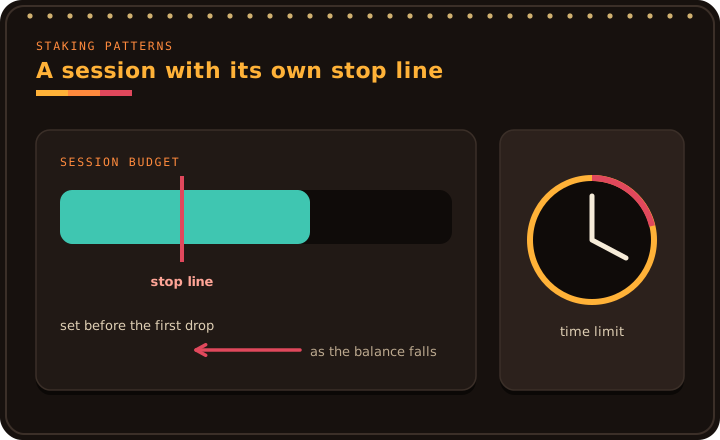
The one pattern that changes an outcome you control: a loss limit and a time limit set before the session starts, and kept when the bar reaches them.
The info or rules icon inside the game window, usually near the stake field.
The game's own page in the casino, reached from the tile rather than from the play button.
For a studio title, the studio's page for that game; for a house version, the casino's own game description.
If none of these prints a return figure, treat it as unknown rather than guessing one. Studios do not all print it the same way. Spribe's Plinko page gives a single RTP of 97%, BGaming's gives 99%, and Hacksaw Gaming lists seven RTP versions for its Plinko, from 98.98% down to 88.20%. With a list like that, the rules panel inside the lobby you are using is the only place that shows which version is loaded.
A casino page can also print its own figure for a studio game. Bitcasino.io's page for Spribe's Plinko shows 96%, one point below the studio's own figure, so read both and plan around the lower one. The paytable reading guide shows where the figures appear on the board itself.
The bet size is the lever that matters
Because a setting cannot change what the game keeps, the stake is the one number that decides how much a session can cost. A simple way to set it is to decide the session budget first and divide.
Three lines to write down before the first drop
Session budget: the amount you are prepared to lose tonight, taken from money you do not need.
Bet per drop: a small slice of that budget. At one hundredth of the budget, even a run of low landings leaves room for many drops.
Stop point: the balance at which you close the game, up or down.
High-risk, many-row settings need a smaller slice. Most drops on those boards return well under the stake, so a budget built for a low-risk board runs out much sooner there. The edge and centre explainer has the path counts behind that.
Session limits and a stop-loss
A stop-loss in Plinko is not a trick for keeping winnings; it is a line that ends the evening before the budget does. It works best when something other than willpower enforces it.
Deposit limits: many casinos let you set a daily, weekly or monthly deposit ceiling in the account area. Lowering one normally applies at once; raising one often waits a cooling-off period set by the casino.
Session reminders or time-outs, where the account settings offer them.
A separate wallet for play money, so a transfer into the casino is a deliberate step.
A stop-win line helps too. Deciding in advance that a session ends after a large landing stops a good result from flowing straight back into the next hundred drops.
Martingale on a Plinko board, as arithmetic
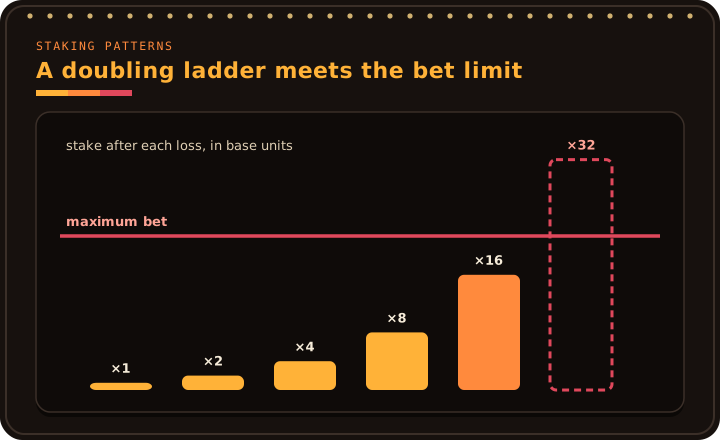
Plinko has no clean win or loss, so the Martingale version people try doubles the stake after any drop that returns less than it cost. Start at 1 unit and seven such drops in a row take the stakes to 1, 2, 4, 8, 16, 32 and 64 — 127 units put in — with the eighth stake at 128.
Doubling after every loss needs an endless ladder. The table has a ceiling on a single bet, and a run of losses reaches it long before a balance feels large.
On a high-risk board a run of seven sub-stake landings is ordinary, because most slots there pay below 1×. Suppose a made-up game caps the stake at 100 units: the sequence cannot place its eighth drop at all, and the whole run ends with the loss already taken. Doubling does not recover losses in any reliable way, and each of those eight drops carries the same house edge as the first. Other progressions, such as Fibonacci or D'Alembert, rearrange the same arithmetic without changing that edge.
Autoplay and turbo mode
Autoplay is the setting people forget to count. It does not change any single drop, but it multiplies how many drops happen in an hour, and total money staked is what the house edge applies to. Doubling the drops doubles the long-run cost of the same session.
If you use autoplay, set its own limits: a fixed number of drops, a stop on a total loss, and a stop on a single large landing. Most Plinko panels offer these fields; leave none of them blank.
Apps and tips that claim to know the next bin
Paid apps and channels that claim to read the next landing are false. A predictor cannot see a result the game has not produced yet, and with a seed-based game the server seed is fixed and hidden until after it rotates. Anyone selling a hack for a Plinko board is selling nothing more than the chance to lose the subscription fee as well. If you want certainty about a drop, the seed verification steps show how to confirm it was not changed afterwards — which is all anyone can confirm.
A plinko strategy checklist for one session
Find the return figure in the rules panel or game page; if none is printed, treat it as unknown.
Set the session budget, the stake per drop and the stop point before opening the game.
Pick rows and risk for how much swing you can sit through, not for the size of the edge figure.
If autoplay is on, fill in the drop count and both stop fields.
Check the casino's withdrawal cap before a large landing, not after; the caps by clause page shows where they are printed.
Close the game at the stop point, whichever direction it came from.
If Plinko stops being entertainment, step back and talk to someone. Gamblers Anonymous runs meetings in many countries and online, and most casinos let you pause or close an account from the account area.
Questions people actually type
Is there a plinko strategy that wins over time?
No. The paytable of each setting is built around the game's house edge, so no choice of rows, risk or stake pattern turns the long-run expectation positive. What a plan can do is decide how much a session costs at most and when it ends. That is worth doing, but it is budget control, not an advantage over the game.
Is a low-risk setting safer than a high-risk one?
It is smoother, not cheaper over time. Low risk returns small amounts often, so the balance moves slowly. High risk returns little on most drops and occasionally a large amount, so the balance swings harder and a budget can run out sooner. Where the game prints one return figure for all settings, the long-run cost per unit staked is the same.
Does a stop-loss protect my balance?
Only in the sense that it ends the session at a line you chose. It does not change the odds of any drop. It works best when backed by a tool the casino provides, such as a deposit limit in the account settings, and by autoplay stop fields filled in before the first drop, so that the decision is made while you are calm.