Plinko real money withdrawal: caps, ID checks and deposit wagering
A big bin can pay more than a casino lets you take out in one go. Here are the ceilings each ranked casino writes into its terms, the instalment rules, and the deposit wagering line that comes first.
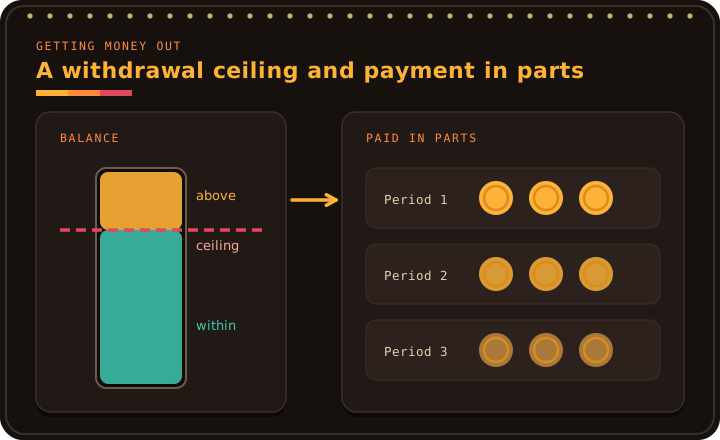
Plinko casino withdrawal limits are the part of the terms most players meet only after a good drop. The game can multiply a stake many times in one ball; after that, a clause in the terms sets the ceiling on each cash-out window and says whether a big balance is handed back in parts. Reading those lines first changes how big a win you can actually take home in one go.
Three things stand between a balance and your wallet
A plinko real money withdrawal passes through three filters, in this order:
Deposit wagering. Some terms require the deposit to be played through before any withdrawal.
Identity. An ID clause can apply at the first payout or on a trigger event; see the page on ID clauses.
The cap. A ceiling per period, sometimes with an instalment rule for large sums.
Each filter lives in a different clause, and all three can apply to the same request. Those same three filters, one clause at a time, are what the plinko casino sites page lines up for every casino in the deck.
Deposit wagering before the first withdrawal
Vave's cl. 8.11 is the clearest example in the deck. Money paid in has to go round three times in casino or live stakes (a single time if it goes on sports) before any of it can be requested back. The rule covers the deposit itself, bonus or no bonus.
A ceiling is a line per period, not a verdict on the win. What sits above the line either waits for the next period or leaves in parts, if the terms say so, and the clause that says so is the one to find.
In practice, that means a deposit of 100 USDT needs 300 USDT in casino stakes before it can be withdrawn, whether the balance went up or down in the meantime. If you deposit and change your mind an hour later, check that clause first.
Other ranked casinos may print their own version of this rule; search the terms for “turnover” or “wagered” near the withdrawal section.
Plinko casino withdrawal limits, card by card
These are the caps and instalment lines printed in each casino's terms, with the clause.
Weekly and monthly ceilings
Bitcasino.io: large requests are handled against a weekly ceiling of 1 million USDT (cl. 6.10).
Winz.io: 100,000 USDT a week and 400,000 USDT a month (cl. 11.7).
Blockbet: €10,000 a month; the figure halves to €5,000 once the account balance is ten times what was deposited (cl. 8.6).
TG.Casino: €150,000 per rolling 30 days (cl. 9.6).
Winna: US$10,000 per 24 hours (cl. 8.7).
Instalments for large sums
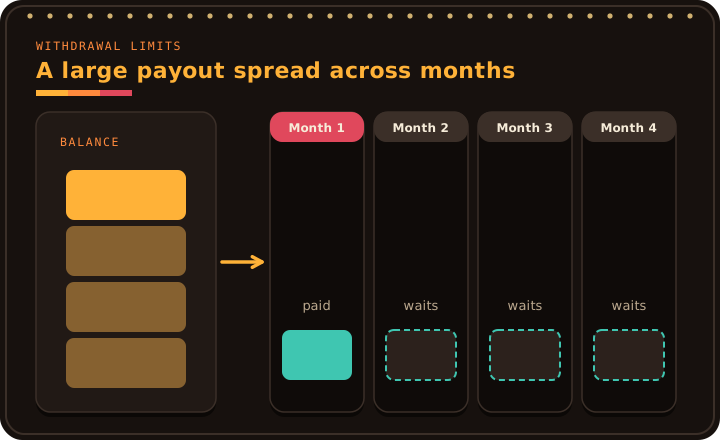
Rocketpot: after a large win, anything from US$5,000 upward is split into monthly parts, each no bigger than US$5,000 (cl. 11.5).
Metaspins: no upper cap, but large sums may be paid in instalments (cl. 12.5).
Vave: cl. 8.8 sets no ceiling per period, yet keeps an exception: winnings of 50,000 USDT or more can be split into equal parts.
No ceiling printed, or left to the operator
Rainbet: no upper cap; a US$15 minimum (cl. 8.1).
Bitsler: cl. 8.6 leaves the floor and the ceiling to Bitsler's own discretion, so the figure lives in the cashier, not the terms.
Sportsbet.io, Shuffle.com and Hyper Lucky have no cap recorded on their cards. Treat that as a reason to ask support before a large request, not as proof that none exists.
A plinko real money withdrawal after a big bin: worked example
A hypothetical session shows why caps matter more on Plinko than on steady games. On its game page (read 16 September 2026), BGaming lists 1,000× as the highest value its Plinko board can show. Suppose a made-up stake of US$20 lands in that top bin: the balance jumps by US$20,000 in one ball.
Here is how the same US$20,000 would leave under three different clauses in this example:
Under a US$10,000 per 24 hours cap (Winna, cl. 8.7), it goes out as two requests on two different days.
Under a €10,000 monthly cap (Blockbet, cl. 8.6), the sum needs more than one month, and the lower €5,000 line applies if that balance is ten times the deposits.
Under US$5,000 monthly instalments (Rocketpot, cl. 11.5), four monthly payments.
None of these numbers is a prediction. Top bins land very rarely: on a 16-row board each edge bin is reached by 1 of 65,536 paths. The point is to know before you raise the stake which cap would apply if the rare drop comes.
Minimums and the practical floor
A minimum withdrawal is a cap from the other side. Rainbet prints US$15 in cl. 8.1, and Bitsler lets the operator set it. A balance below the minimum stays in the account until you top it up or play it down. The network fee on top of that is explained in the note on fees charged on the way out.
An instalment clause does not cap a win, it schedules it: one part per period, the rest waiting in the account until the next period opens.
If you play small stakes, compare the minimum with your usual cash-out size. A floor that looks low in dollars can be a large share of a small balance.
Planning a plinko real money withdrawal in steps
Big requests go more smoothly when they are prepared, not improvised after the ball lands.
Check the balance coin against the cap currency. A cap in USDT and a balance in BTC will not line up exactly, because the BTC value moves.
Clear the wagering line first. If cl. 8.11-style turnover is still open, a request can stop there.
Have ID ready. Where a clause prints a sum, a large request is the obvious moment for it to switch on.
Split the sum yourself if the cap is per day or per week. Send one request per period rather than one oversized request that support has to break up.
Keep a record. Note each request, its amount and the clause it relied on.
This is dull work, and it is the part that turns a screen balance into money in your own wallet.
How to read plinko casino withdrawal limits before you deposit
Search the terms for “withdrawal”, “maximum”, “per week”, “per month” and “instalment”.
Note whether the cap is per day, per week, per calendar month or per rolling period; they are not the same.
Note the currency of the cap (USDT, € or US$) and compare it with your balance coin; the coins and cashier guide helps with that.
Look for a separate rule for large wins or jackpots.
Check the deposit wagering clause, which can block a request before any cap is reached.
Read the ID clause, because a check can come before the cap matters.
Set your own ceiling too: decide in advance how much of a win you will withdraw, and do it before the next session. If chasing losses starts to feel normal, Gamblers Anonymous is one place to talk.
Questions people actually type
Is a weekly cap the same as a rolling seven-day cap?
Not necessarily. A calendar week resets on a fixed day, while a rolling period counts back from each request. TG.Casino, for example, writes its €150,000 ceiling per rolling 30 days in cl. 9.6, which is different from a calendar month. Read the exact wording in the clause, and ask support in writing if the terms leave it unclear.
What happens to a win that is larger than the cap?
The balance stays in the account and leaves in several requests or instalments, as the terms describe. Under Rocketpot's cl. 11.5 a large win of US$5,000 or more leaves in monthly slices capped at US$5,000, and Metaspins keeps the option to split large sums (cl. 12.5). Keep playing that balance only if you mean to.
Does Vave's deposit wagering rule apply without a bonus?
Yes. Cl. 8.11 of Vave's terms targets the deposit, not a promotion: triple turnover in casino or live games, or one pass on sports, comes before the cashier releases anything. A bonus brings its own terms on top. Read both before depositing if you expect to cash out soon.