Plinko casino without ID: when documents can still be requested
A crypto deposit rarely asks for a passport, but the terms behind it almost always keep the right to. This page shows where that right is written, when it switches on, and what the two money tests saw.
People type “plinko casino no KYC” hoping for an account that never asks who they are. What the terms of the ranked casinos actually offer is narrower: an account you can open and fund, and an identity clause that can wake up later, most often when money is on its way out. Knowing which line in the terms does that is worth more than any label on a homepage.
Plinko casino no KYC: what the phrase really buys
Every one of the thirteen casinos in the deck, Vave included, prints an ID clause. None of them promises that documents will never be requested. The difference between them is not “checks or no checks” but three details:
The moment. Some tie the check to a withdrawal, others to a trigger event such as a sum, a pattern or a review.
The sum. Some write an amount into the clause; others leave it open.
The deadline. Some give you a fixed period to send documents; others say nothing about time.
These are the first four of the five points each card is scored on, so the ranking cards on the deck of Plinko lobbies already show which casino prints what.
Where to find the clause
Open the terms and search the page for “identity”, “verification”, “KYC” or “documents”. The clause usually sits in the account section or the withdrawal section, and it often points to a separate KYC or AML policy. Read both if there are two. That same clause sits beside the licence and the withdrawal cap on the plinko casino sites page, where every casino in the deck is compared side by side.
When documents can be requested, casino by casino
Here is what the clause numbers in the deck say about the moment.
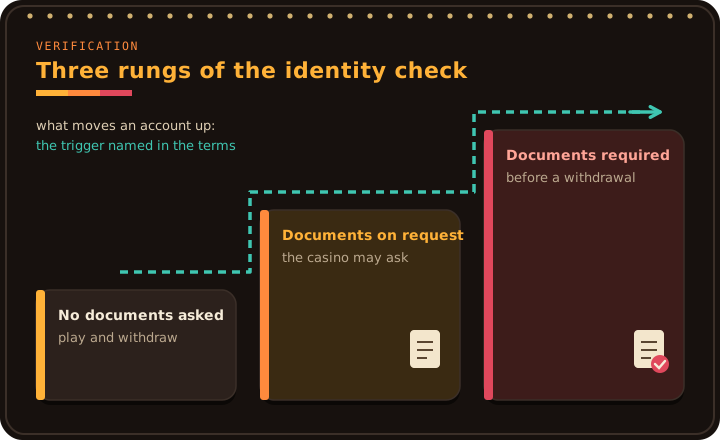
Three positions a casino’s terms can take, drawn as steps. What matters on each card below is which step the clause describes and what, in its own words, moves an account up.
At withdrawal:
Vave, cl. 8.7: ID may be asked before any payout.
Rocketpot, cl. 11.4 and 12.4.
Sportsbet.io, cl. 6.5 and 6.6.
Winz.io, cl. 8.4 and 11.10.
Blockbet, cl. 8.3 together with its KYC Policy.
Rainbet, cl. 20.1.
TG.Casino, cl. 9.3.
On a trigger event:
Bitcasino.io, cl. 3.13 and 6.6.
Metaspins, cl. 9.7.
Shuffle.com, cl. 5.2.
Winna, cl. 6.1, 6.2 and 8.5.
Hyper Lucky, cl. 10.3 and 8.13.
No moment named: Bitsler has an identity clause (cl. 8.22, with 4.3), but it does not say when the check begins. That is one of the reasons it sits last among the numbered cards.
Sums and deadlines written into the terms
A sum tells you roughly where the line is; a deadline tells you how long the account can wait on you.
Sums
Bitcasino.io: €2,500, or the same value in coins.
Rocketpot: US$2,000 in one clause and US$2,500 in another, so read both.
Sportsbet.io, Blockbet, TG.Casino, Winna and Hyper Lucky also print an amount in their clause; open the terms for the figure before counting on it.
A sum is not a safe zone. Read the whole clause: if it also keeps a general right to ask, the number is a likely trigger rather than a ceiling on checks.
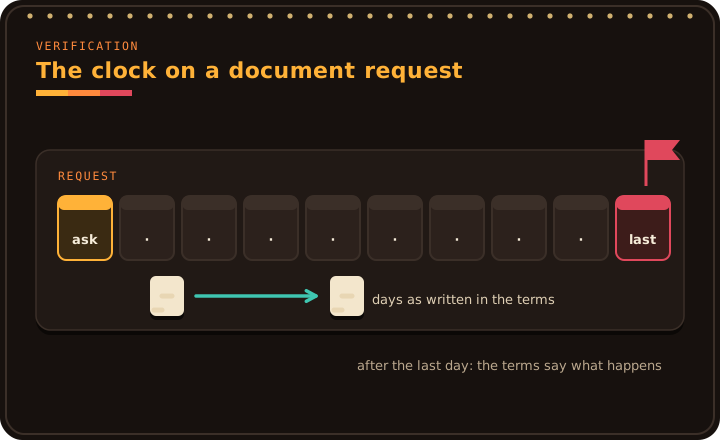
Deadlines for documents
Rainbet: 72 hours (cl. 20.1).
Vave: 14 days (cl. 8.7).
Rocketpot: 30 calendar days (cl. 12.2).
Metaspins: 30 days (cl. 9.10).
Winz.io also sets a deadline in its terms.
The deadline is the practical part. If a request lands while you are away, the clock is already running, so check the email tied to the account.
Plinko no verification in practice: the two money tests
Two casinos were tried with the editors' own funds, and both show how a quiet account can change.
Vave, 28 August 2026. Own funds went in, and own funds came back to the editors' wallet. Up to a combined total of roughly 5,000 USDT, no document was requested on the way out. Read that as a single account in a single stretch of time, which proves nothing general, because cl. 8.7 keeps Vave's right to request ID ahead of any payout.
TrustDice, May 2026. The editors paid in USDT across several weeks. Cash-outs left the account with no check at all until their sum crossed roughly US$5,000. The one after that stopped at the status “payment under review”, and a compliance email arrived carrying a Veriff link. The driving licence sent first was refused, and the passport was only accepted on attempt number five. Some time later TrustDice emailed for documents a second time.
The lesson from both: “plinko no verification” describes how an account behaved for a while, not what it is entitled to. Terms outrank experience, and a quiet first month says little about the fifth withdrawal.
Plinko casino without ID: a sensible way to play
Plinko casino without ID is how many searches start, and it is reasonable to prefer an account that asks late. Plan around the clause instead of hoping it stays asleep.
Some terms give a fixed number of days to send documents once they are asked for, and say what happens to the balance after that. The count starts on the request, not on sign-up.
Note the clause number and its deadline in your own notes before money goes in.
Keep deposits and withdrawals in the same coin and the same wallet where the cashier allows it, so the payment trail is easy to follow.
Have a clear photo of a valid document ready, so a request does not stall a balance.
Never send someone else's documents or edited scans.
If a request arrives, answer inside the deadline and keep copies of what you sent.
Lists built around that search phrase often suggest there is a casino where checks cannot happen. Among the operators here, there is none; there are only casinos that ask later rather than sooner. The same logic applies to how much can leave at once, covered on the caps and instalments page.
What a request usually looks like
A document request rarely arrives as a surprise pop-up in the middle of a drop. It tends to appear at the cashier, as a withdrawal status that stops moving, or as an email to the address on the account. Read it for three things: which documents, by when, and what happens to the pending payout meanwhile.
Which documents. Usually a photo ID, sometimes proof of address or a screenshot of the wallet that funded the account.
By when. Compare the date in the email with the deadline clause; if they differ, the terms decide.
The pending payout. Look for a line on whether the withdrawal waits for the check; if the email is silent, ask support in writing.
Before you hit upload, crop nothing important, make sure all four corners of the document are visible, and send files in the format the email asks for. A clean first upload saves a second round.
Plinko no verification searches and Plinko sessions
Someone searching “plinko no verification” is usually thinking about the game, but the check never looks at the game. It looks at the account: deposits, withdrawals, the wallet and the person. A long Plinko session at high risk can move a balance up and down quickly, and a sudden jump is exactly the kind of event a trigger clause may describe. That is why the ID clause belongs on your reading list before the first drop, not after the best one.
Plinko casino no KYC checklist
Search the terms for the identity clause and note its number.
Note the moment: withdrawal or trigger event.
Note any sum and any deadline.
Look for a separate KYC or AML policy linked from the clause.
If gambling stops being fun, stop depositing and talk to someone. Gamblers Anonymous runs meetings internationally.
Questions people actually type
Can I find a plinko casino without ID checks at all?
Not among the ranked casinos. Each of them prints an identity clause, and several tie it to the first withdrawal. Some accounts go a long time without a request: in the Vave test on 28 August 2026 withdrawals up to about 5,000 USDT in total came through without a check. The clause still allowed one at any payout.
What is the time allowed for uploading my documents?
It depends on the terms. Rainbet gives 72 hours under cl. 20.1, Vave 14 days under cl. 8.7, Rocketpot 30 calendar days under cl. 12.2 and Metaspins 30 days under cl. 9.10. Where the terms print no deadline, reply as soon as you can and keep proof of when you sent the files.
Does playing Plinko rather than slots change the ID rules?
No. The identity clause belongs to the account, not to a game. A Plinko session funds and drains the same balance as any other title, so the same moment, sum and deadline apply. What can differ is how fast a large edge-bin hit brings a balance up to a sum written in the clause.