Twelve casino lobbies with a Plinko tile in them, each read through its own terms: whose game sits behind the tile, what the cashier lists, when documents can be asked for and how much may leave in one go.
Plinko casino sites look alike from the doorway: a triangle of pegs, a falling ball, a strip of coloured bins at the bottom. The real differences sit one layer down, in whose game the tile actually opens and in the account rules printed around it. Walk the floor with us, one lobby at a time.
Each numbered card starts with the Plinko you will meet in that lobby, then turns to the parts that decide what happens to your balance: licence, identity clause, withdrawal cap and coins. Some people type plinko gambling sites or just plinko sites into a search bar; the ground is the same, and so are the questions worth asking. If you want to know who assembles the deck and how corrections are handled, the page about the people behind these cards covers it.
Plinko SpribePLINKO house versionseen in its lobby 16 Sep 2026
Licence
Curaçao · register: activeregister, 12 Sep 2026
Coins
12–13 on the list
Identity check
On a trigger eventcl. 3.13, 6.6
Withdrawal cap
Up to 1 million USDT a week (cl. 6.10)
2Rocketpot
Plinko house versionseen in its lobby 16 Sep 2026
Licence
Curaçao · portal: not validregister, 13 Sep 2026
Coins
13 on the list
Identity check
At withdrawalcl. 11.4, 12.4
Withdrawal cap
US$5,000 a month after a large win (cl. 11.5)
3Sportsbet.io
PLINKO house versionPlinko BGamingseen in its lobby 16 Sep 2026
Licence
Curaçao · register: activeregister, 16 Sep 2026
Coins
5 named, list left open
Identity check
At withdrawalcl. 6.5, 6.6
Withdrawal cap
—
4Winz.io
Plinko SpribePlinko BGamingPlinkoX house versionseen in its lobby 16 Sep 2026
Licence
Anjouan and Tobiqueregister, 24 Aug 2027
Coins
12 on the list
Identity check
At withdrawalcl. 8.4, 11.10
Withdrawal cap
100,000 USDT a week · 400,000 USDT a month (cl. 11.7)
5Blockbet
Plinko X Classic SmartSoftPlinko house versionseen in its lobby 16 Sep 2026
Licence
Anjouan · valid until 13 March 2027register, 16 Sep 2026
Coins
—
Identity check
At withdrawalcl. 8.3; KYC Policy
Withdrawal cap
€10,000 a month; €5,000 when the balance is ten times the deposits (cl. 8.6)
6Metaspins
Plinko house versionPlinko Spribeseen in its lobby 16 Sep 2026
Licence
Anjouan in the terms, Curaçao in the registerregister, 12 Sep 2026
Coins
—
Identity check
On a trigger eventcl. 9.7
Withdrawal cap
No upper cap; large sums in instalments (cl. 12.5)
7Rainbet
Plinko house versionseen in its lobby 16 Sep 2026
Licence
No licence number publishedregister
Coins
9 named, list left open
Identity check
At withdrawalcl. 20.1
Withdrawal cap
No upper cap; US$15 minimum (cl. 8.1)
8Shuffle.com
Plinko house versionPlinko Hacksaw Gamingseen in its lobby 16 Sep 2026
Licence
Curaçao · register: activeregister, 8 Sep 2026
Coins
—
Identity check
On a trigger eventcl. 5.2
Withdrawal cap
—
9TG.Casino
PLINKO house versionPlinko BGamingseen in its lobby 16 Sep 2026
Licence
No licence number publishedregister, 16 Sep 2026
Coins
—
Identity check
At withdrawalcl. 9.3
Withdrawal cap
€150,000 per rolling 30 days (cl. 9.6)
10Winna
Plinko house versionseen in its lobby 16 Sep 2026
Licence
Tobique · holder list without domainsregister, 8 May 2027
Coins
10 named, list left open
Identity check
On a trigger eventcl. 6.1, 6.2, 8.5
Withdrawal cap
US$10,000 per 24 hours (cl. 8.7)
11Hyper Lucky
Plinko TaDa Gamingseen in its lobby 16 Sep 2026
Licence
Anjouan · expiry date passedregister, 28 Aug 2026
Coins
—
Identity check
On a trigger eventcl. 10.3, 8.13
Withdrawal cap
—
12Bitsler
Plinko house versionPlinko BGamingPlinko Hacksaw Gamingseen in its lobby 16 Sep 2026
Licence
Curaçao · register: activeregister, 12 Sep 2026
Coins
—
Identity check
On a trigger eventcl. 8.22, 4.3
Withdrawal cap
Operator sets the minimum and maximum (cl. 8.6)
More casinos in the deck, without a score
Thunderpick
BetFury
WinDice
Wolfbet
Coins.Game
TrustDice
Wild Fortune
Jack.com
Wild.io
Plinko casino sites as cards. The number follows the five checks on account rules, and a card gets its number only once a Plinko tile showed up in the casino lobby itself, checked 16 September 2026. Names under the deck carry no score.
How the best Plinko casino sites are ordered
Every numbered card carries a score out of five. Only two sources feed those points: the casino's printed terms and the licence list of whichever authority issued its permit. One point per check:
An ID clause is printed. The terms say in so many words that documents may be requested.
The clause names a moment. It says when the check starts, such as at withdrawal or after a trigger event.
A sum is written in. A figure tells you roughly where a request becomes likely.
Documents have a deadline. The terms give a number of hours or days for sending them.
The register agrees. Search the issuing authority's list, and this exact domain appears beside the licence.
A casino only gets a number when two things hold: Plinko turned up on that casino's own lobby or game page during the 16 September 2026 visit, and its terms gave enough to score. Game count, bonus size and speed play no part in how the best Plinko casino sites line up here. The full scoring method with examples shows how each point is decided, and a separate walk-through explains how to look a licence number up yourself.
Twelve Plinko casino sites, card by card
The cards run from the highest score down. Every one is laid out in the same order, so any two Plinko casino sites in the deck can be compared line against line.
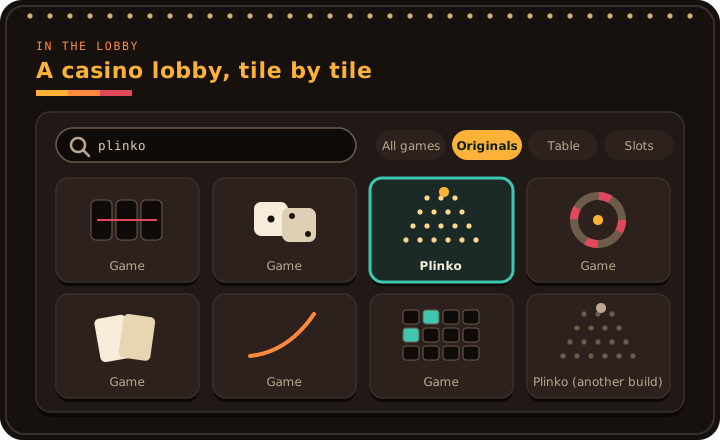
A drawing of a lobby, not a capture of one: the tiles are generic shapes, and the only thing that matters here is that Plinko is a tile you search for, not a section every lobby has.
1. Bitcasino.io
Two Plinko tiles share this lobby. Spribe's Plinko sits on the Spribe provider page, and a house game called PLINKO fills a slot in the Bitcasino Originals row. Spribe's own game page prints an RTP of 97%. The casino's provider page quotes a different figure for the same title, so read the number inside the game's info panel before the first drop.
Its licence is OGL/2023/111/0069 from Curaçao, in the name of Moon Technologies B.V., and bitcasino.io stood among the certificate's domains at the 12 September 2026 lookup. ID can be requested after a trigger event (cl. 3.13, 6.6), with €2,500 or its value in coins as the named threshold. Large requests are capped at 1 million USDT a week (cl. 6.10), and the cashier lists 12–13 coins. Check before depositing: the per-coin minimum in cl. 5, because a deposit below it is void.
2. Rocketpot
Rocketpot runs its own Plinko, filed under Exclusive Games with no outside studio credited; the game page gives a release date of 13 August 2025. Its terms (cl. 1.2) quote Curaçao licence 1668/JAZ, and the cert.cga.cw portal returned that certificate as not valid on 12 and 13 September 2026.
Identity checks start at withdrawal (cl. 11.4, 12.4), with thresholds of US$2,000 and US$2,500 in two separate clauses, and cl. 12.2 allows 30 calendar days for documents. After a large win, sums from US$5,000 are paid in monthly instalments of no more than US$5,000 (cl. 11.5). Thirteen coins sit on the cashier list, with a floor of 0.001 BTC per deposit (cl. 10.2). Check before depositing: search the register for 1668/JAZ yourself and see what it says today.
3. Sportsbet.io
Sportsbet.io shows its own PLINKO in the Originals row and BGaming's Plinko among the casual games. The house version's page states that it has no fun mode. BGaming's sheet for its title lists an RTP of 99%, three risk levels (high, normal, low), 8 to 16 lines and a top multiplier of 1,000×.
MBet Solutions N.V. holds Curaçao licence OGL/2023/110/0072, granted 22 July 2024; the register showed it active for sportsbet.io on 16 September 2026, and the number quoted in the terms, cl. 1.2, matches it. Documents come into play at withdrawal (cl. 6.5, 6.6), and the clause names a sum. The cashier names five coins and leaves the list open. Check before depositing: which of the two tiles you mean to play, since the house one cannot be tried for free.
4. Winz.io
Three Plinko titles turn up here: Spribe's Plinko, BGaming's Plinko and a tile named PlinkoX whose link credits no studio. The Spribe game page on Winz.io prints a house edge of 3%, which lines up with the 97% RTP on Spribe's own sheet.
The terms (cl. 1.1) point to a Tobique licence, number 0000002, issued to Novatrix SRL; Tobique's list of holders shows company names only. On 16 September 2026 the Anjouan register had winz.io filed with Novatrix SRL on ALSI-202508056-FI2, good until 24 August 2027. ID requests are tied to withdrawal (cl. 8.4, 11.10) and carry a document deadline. The weekly cap is 100,000 USDT and the monthly one 400,000 USDT (cl. 11.7); cl. 4.1 lists 12 coins. Check before depositing: which of the two authorities the footer shows on the day you sign up.
5. Blockbet
SmartSoft's Plinko X Classic has a live game page at Blockbet, and a BlockBet Originals Plinko tile stands in the lobby as the house version. SmartSoft's own sheet for Plinko X Classic prints no return figure, so the 97.00% RTP and 3.00% house edge on Blockbet's page are the casino's numbers rather than the studio's.
Anjouan licence ALSI-202603013-FI1 belongs to 3-102-953229 SRL; it was issued on 14 March 2026, runs until 13 March 2027, and the same number appears in the footer. On 16 September 2026 the register entry included blockbet.gg. ID checks begin at withdrawal (cl. 8.3 and the KYC Policy), and the clause states a sum. The monthly cap is €10,000, dropping to €5,000 once the balance reaches ten times the deposits (cl. 8.6). Check before depositing: hold that ten-times ratio against your own deposit history before a long session.
6. Metaspins
Metaspins has a Plinko tile marked ORIGINALS, a Spribe Plinko, and a third Plinko tile with no studio printed on it. Spribe's sheet gives an RTP of 97% and nothing more.
The licence picture is split in two. In its terms (cl. 1.1) the casino names Anjouan and ALSI-202606048-FI2. The Curaçao register tells another story: on 12 September 2026 it showed OGL/2024/1063/0437 for Metaspins N.V., active, with metaspins.com attached. Both stand on this card side by side. An ID check follows a trigger event (cl. 9.7), and cl. 9.10 gives 30 days for documents. Withdrawals from a Plinko casino balance here have no upper cap, though cl. 12.5 lets large sums go out in instalments. Check before depositing: ask support in writing which of the two licences covers your account.
7. Rainbet
Rainbet's Plinko is a house game: the site menu lists it among the Rainbet Originals, alongside Limbo, Mines, Keno and Dice. Rainbet describes its Originals as running on provably fair logic.
The footer seal carries no licence number, and cl. 21.6 points to Gaming Services Provider N.V. for the authority. Identity documents are due at withdrawal under cl. 20.1. That clause gives you 72 hours to send them. No upper cap appears in the terms, while the minimum is US$15 (cl. 8.1). The cashier names nine coins and leaves room for more. Check before depositing: have a clear scan of your ID ready, because 72 hours passes quickly on a busy week.
8. Shuffle.com
Shuffle.com carries a house Plinko under its originals and Hacksaw Gaming's Plinko on a separate game page. Hacksaw's sheet prints seven RTP versions, from 98.98% down to 88.20%, together with low, medium and high risk and 8 to 16 rows; the top win it names is 3,843.3×.
Curaçao certificate OGL/2024/1337/0628 is in the name of Natural Nine B.V.; issued on 16 October 2024, it came up active in a register search on 8 September 2026. Documents may be requested after a trigger event (cl. 5.2), and the clause sets no sum. Check before depositing: open the Hacksaw game's rules panel and note which of the seven RTP versions this lobby shows, since the gap between the highest and the lowest is more than ten points.
9. TG.Casino
TG.Casino shows BGaming's Plinko, whose studio sheet lists a 99% RTP, three risk levels and up to 16 lines, plus a second page titled PLINKO that prints no studio name at all.
Complaints, says cl. 22.6, go to Gaming Services Provider N.V., and the terms give no licence number anywhere. A cert.cga.cw lookup for tg.casino on 16 September 2026 returned no results. ID can be asked for at withdrawal (cl. 9.3), and the clause names a sum. The cap is €150,000 per rolling 30 days (cl. 9.6). Check before depositing: with no number in the terms, ask support which certificate the site runs under and search the register for it.
10. Winna
Winna's Plinko is its own: the game page credits Winna Originals and no outside studio.
GG Gaming S.R. L. is the company named in both the terms and a help article, placed under Tobique without any number. Tobique's holder list, as opened on 16 September 2026, carries GG Gaming S.R. L for B2C business through 8 May 2027 but shows no domains, which leaves winna.com unmatched. ID requests follow a trigger event (cl. 6.1, 6.2, 8.5), and the clause gives a sum. The limit is US$10,000 per 24 hours (cl. 8.7). Ten coins are named and the list stays open. Check before depositing: if you play for a large balance, work out how many daily slices it would take to move it.
11. Hyper Lucky
Hyper Lucky's lobby holds a Plinko from TaDa Gaming, and the tile asks you to sign in before play. TaDa Gaming prints no RTP, rows or top win for the game, so those fields show a dash on this card.
The terms name Brightsky Limited with ALSI-202508057-FI2. Opened on 16 September 2026, the Anjouan register has hyperlucky.com under BrightSky Ltd and that same number, marked valid, even though the expiry date printed there, 28 August 2026, is already behind us. ID checks follow a trigger event (cl. 10.3, 8.13), and the clause names a sum. Check before depositing: look the entry up again and see whether the expiry date has moved.
12. Bitsler
Bitsler carries three: its own Plinko, which the page describes with 8 to 16 rows and low to high risk, plus BGaming's Plinko and Hacksaw Gaming's Plinko. Bitsler's homepage claims provably fair technology for every game; that cannot extend to titles made by other studios.
Oyine N.V. is the name on OGL/2024/930/0387 (Curaçao, issued 22 July 2024). A register search on 12 September 2026 found bitsler.com attached to it, while the terms keep describing an application. Documents can be requested (cl. 8.22, 4.3), with no moment, sum or deadline attached. Under cl. 8.6 the operator sets both the smallest and the largest withdrawal. Check before depositing: ask support for today's maximum and keep the answer.
More casinos stand in the deck after these twelve, shown by name and without a score.
House original or studio Plinko: which tile a Plinko casino hands you
Most plinko gambling sites in this deck mix two kinds of Plinko. A studio title is built by an outside company and credited on the tile or game page; a house version carries the casino's own name, or the word Originals, and no studio at all. The two can share artwork and even the same name, so the credit line is what tells them apart.
Sixteen balls, one board
Sixteen releases down an eight-row board. Nothing steers them and nothing is weighted — the heap builds in the middle because more routes end there, and that is the only reason.
The difference matters because a studio publishes a sheet you can compare with what the lobby shows. On 16 September 2026 those sheets read like this:
Spribe prints an RTP of 97% for its Plinko and nothing else.
BGaming prints an RTP of 99%, risk levels high, normal and low, 8 to 16 lines and a top multiplier of 1,000×.
Hacksaw Gaming lists seven RTP versions (98.98% at the top, 88.20% at the bottom), rows from 8 to 16, three risk settings called low, medium and high, and a maximum win of 3,843.3×.
SmartSoft and TaDa Gaming print none of these values: a dash.
A house version has no outside sheet. Its paytable, return figure and seed tools live only inside the casino's game panel and help pages. A Plinko casino that offers only its own version, as Rocketpot, Rainbet and Winna do, leaves that panel as your single source; Hyper Lucky, the other way round, shows only a studio title. The guide to house originals and studio titles goes through the credit line, the game page and the rules panel in more detail, and the page on checking a single drop with seeds explains the fairness tools most house versions offer.
The settings panel: rows and risk in practice
On most plinko gambling sites the game opens with two dials beside the stake field. One sets the number of rows, the other a risk level. Across Plinko casino sites the studio sheets name them differently (BGaming says lines and normal, Hacksaw says rows and medium), but the job is the same.
How many routes end in each bin
1
8
28
56
70
56
28
8
1
The counts under the bins of an eight-row board: 1, 8, 28, 56, 70, 56, 28, 8 and 1, and they add up to 256. Multiply two by itself eight times and you have every route down. The end bins are reached by one route each; the middle by seventy.
How often, against how it pays
The upper row is how often each bin is reached. The lower row is the shape of the price list printed underneath it — the same row, read backwards. The lower row carries no figures here on purpose: a multiplier is a statement about one operator’s game, and no operator in this table publishes one where it could be read.
Rows first. A board with n rows ends in n + 1 bins, and the ball reaches the middle far more often than either edge. Here is the one number worth carrying to the table: on 16 rows, 12,870 of the 65,536 possible paths end in the centre bin, and only one path ends in each edge bin. Size your stake as if you will not see that edge in a normal session, because you almost certainly will not.
Risk next. Moving the risk dial swaps the paytable printed under the bins; it never changes the path the ball takes. More rows push the edge values further out and make them rarer still. A practical habit:
change one dial at a time, and read the paytable after each change;
write down the edge and centre values for the setting you actually use;
keep the stake fixed while you get a feel for how often the centre pays.
A lobby visit turns into money at the cashier, and the coin list on each card is the operator's own. Bitcasino.io lists 12–13 coins, Rocketpot 13, Winz.io 12 (cl. 4.1). Winna names ten and Rainbet nine, both leaving their lists open, and Sportsbet.io names five the same way.
A few habits keep deposits clean:
Read the per-coin minimum. Bitcasino.io voids a deposit below the minimum for that coin (cl. 5); Rocketpot starts at 0.001 BTC (cl. 10.2).
Match the network. Pick the same network on the casino's deposit screen and in your wallet. A transfer on the wrong one cannot be pulled back.
Copy the memo or tag when the coin needs one, together with the address.
Think about the balance currency. A USDT balance keeps its dollar value between sessions; a BTC balance moves with the coin even while you are not playing.
Caps are written in different units too: USDT at Winz.io, euros at Blockbet and TG.Casino, US dollars at Winna, which matters when the cashier converts on the Plinko casino sites that hold balances in coins. The coin and network walk-through covers each step, and a separate piece sets out who takes a network fee and who adds one.
ID checks: what Plinko casino terms allow
People browsing plinko gambling sites often hope a crypto lobby means no documents, ever. The terms of the twelve say otherwise, and every Plinko casino among them prints an ID clause. Six tie the check to withdrawal: Rocketpot, Sportsbet.io, Winz.io, Blockbet, Rainbet and TG.Casino. The other six, Bitcasino.io, Metaspins, Shuffle.com, Winna, Hyper Lucky and Bitsler, allow it after a trigger event, which can arrive at any point.
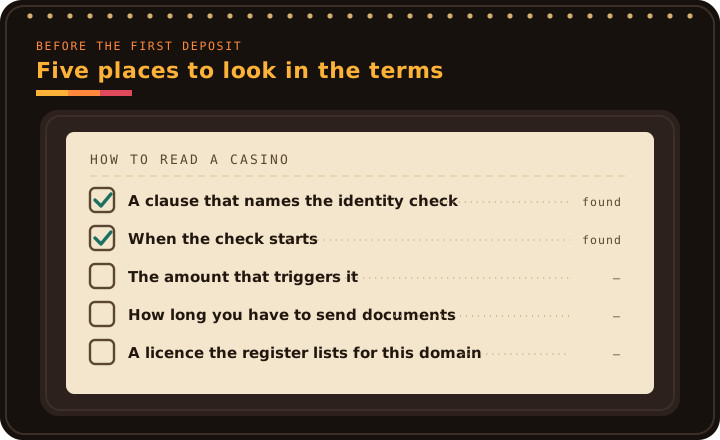
The five checks the cards on this site count, written as a card you could hold next to the terms. A blank on the card means the clause was not found, not that the answer is “no”.
Sums and deadlines give you a sense of scale. Bitcasino.io names €2,500 or its value in coins; Rocketpot names US$2,000 in one clause and US$2,500 in another. Deadlines range from 72 hours at Rainbet (cl. 20.1) to 30 calendar days at Rocketpot (cl. 12.2) and 30 days at Metaspins (cl. 9.10). Vave allows 14 days under cl. 8.7.
Two real-money tests show how this plays out on a single account. Vave, 28 August 2026. Using their own money, the editors made deposits and withdrawals, and no ID was requested for withdrawals adding up to about 5,000 USDT. One account, one period: treat it as an observation and not a promise, because cl. 8.7 still gives Vave the right to ask for ID before any payout.
TrustDice, May 2026. Over several weeks the editors put USDT in and took withdrawals out with no verification, until the running total went past about US$5,000. The following request stalled as payment under review, and an email from compliance arrived carrying a Veriff link. Their driving licence was turned down, and only the fifth upload of a passport got through. Some time later TrustDice emailed asking for documents once more.
The lesson is simple: have a passport scan and a recent address document ready before a large win, not after. The guide to when documents can be requested lists every clause.
Taking money out of a Plinko casino: caps, instalments and wagering
On Plinko casino sites, a big hit is only as good as the route it takes to your wallet. The twelve cards print very different ceilings:
Per day: Winna, US$10,000 per 24 hours (cl. 8.7).
Per week: Bitcasino.io, up to 1 million USDT for large requests (cl. 6.10); Winz.io, 100,000 USDT.
Per month: Winz.io, 400,000 USDT (cl. 11.7); Blockbet, €10,000, or €5,000 when the balance is ten times the deposits (cl. 8.6); TG.Casino, €150,000 per rolling 30 days (cl. 9.6).
In instalments: at Rocketpot, anything from US$5,000 leaves in monthly parts capped at US$5,000 each (cl. 11.5); Metaspins may split large sums (cl. 12.5).
Vave sets no cap per period under cl. 8.8, but a win from 50,000 USDT may exceptionally be paid in equal instalments. Under cl. 8.11 a deposit has to go round before any withdrawal: staked three times over on casino and live games, or once on sports. A worked example: deposit 200 USDT, play Plinko, and 600 USDT in casino stakes need to pass before the first request.
A five-minute check before depositing at the best Plinko casino sites
Before you send a coin to any of the Plinko casino sites on these cards, open the casino's own pages and run through this list:
Add rows, add bins
89
1213
1617
Eight rows give nine bins, twelve give thirteen, sixteen give seventeen. The row count is the one control that changes the arithmetic rather than the price list — and it changes it by making the ends rarer, not by making them pay more.
Tile credit. Is the Plinko a house version or a studio title, and which studio?
Info panel. Which RTP does the game itself show, and does it match the studio sheet?
Footer seal. Is there a licence number, and does the register list this Plinko casino's domain under it?
ID clause. When can documents be requested, from what sum, and how long do you get to send them?
Cap. What is the daily, weekly or monthly ceiling, and does a large win go out in instalments?
Cashier. Is your coin on the list, on which network, and what is the minimum?
If any answer is missing, ask support and keep a screenshot or email of the reply. The same seven questions work on plinko gambling sites outside this deck too.
Apps that promise to call the next bin
Offers circulate on social media, around plinko gambling sites, for tools that claim to read the board. No predictor app, bot or signal channel can tell where the next ball will land, because the result comes from seeds or a random number generator that such tools never see. Whoever sells one is selling something false, and the fee is money gone. What you can do is keep a record of your own play, and reading the round history shows how.
Responsible play on Plinko sites
Plinko is quick, and quick games make it easy to lose track of time and money. The best Plinko casino sites still take real money, so decide your budget before you open the lobby and treat it as spent the moment you deposit. Set a session length and stop when it ends, win or lose. Most cashiers let you set deposit limits in account settings; use them on day one rather than after a bad night. Bet sizing and session plans help with pace, and the page on what bet sizing can and cannot do explains their limits.
If gambling stops being fun, take a break and talk to someone you trust. Gamblers Anonymous runs meetings around the world, free of charge. Gambling is for adults aged 18+ only.
Questions people actually type
What makes one of these plinko casino sites different from another if the game looks the same?
The board may look identical, but the tile can open a house version or a studio title with a different paytable and return figure. Around it, each casino prints its own identity clause, withdrawal cap and coin list. Those account rules decide what happens to a balance, which is why every card leads with the game's origin and then turns to the terms.
Is a house Plinko better or worse than a studio Plinko?
Neither is better by default. A studio title comes with a public sheet from the studio, so you can compare the lobby's figures against it. A house version has no outside sheet, and its numbers live only in the casino's own game panel and help pages. Pick the one whose figures you can actually read before you stake.
Where do I find the RTP of the Plinko in a lobby?
Open the game and tap the info or rules icon; most panels print the figure there. Then compare it with the studio's sheet: Spribe prints 97%, BGaming 99%, and Hacksaw Gaming seven versions from 98.98% to 88.20%. If the panel and the sheet disagree, go by what the game in front of you shows.
Do plinko gambling sites let me play without ever showing ID?
All twelve casinos here print an ID clause in their terms. Half link the check to a withdrawal request; the other half let a trigger event start it whenever it happens. The two real-money tests saw withdrawals pass without checks up to a running total of about 5,000, yet the terms kept the right to ask, and TrustDice did ask.
What does a score of four out of five actually mean?
Four of the five checks passed: an ID clause exists, it names a moment, it prints a sum, it sets a document deadline, and the register lists the licence under the casino's own domain. Among the best plinko casino sites here, the missing point differs, so a four can lack a deadline at one casino and a register match at another.
Which cap matters most after a big Plinko win?
The one written in the terms of the casino you play at. A daily limit such as US$10,000 per 24 hours at Winna moves a balance in slices, while Rocketpot pays sums from US$5,000 in monthly instalments. Read the clause number on the card before your balance grows, not after the win lands.
What does a dash on a card mean?
A dash marks a field where no value is printed, either by the casino in its terms or by the studio on its game sheet. It is not a zero and not a guess. Hyper Lucky's TaDa Gaming Plinko, for example, shows dashes for RTP, rows and top win because the studio gives none of those values.
Are the best plinko casino sites the ones with the most Plinko titles?
No. Game count, bonus size and speed play no part in the order. The score comes only from the five checks on the terms and the register. A casino with three Plinko titles can sit below one with a single house version if its identity clause prints less detail or its licence does not match its domain.
Why do plinko sites show such different coin lists?
Each operator chooses its own coins and networks, and some print a closed list while others name a few and leave the rest open. Bitcasino.io lists 12–13, Rocketpot 13 and Sportsbet.io names five. Check that your coin and its network both appear before you send anything, since a transfer on the wrong network cannot be reversed.
Should I avoid a Plinko casino whose licence does not match its domain?
That call is yours, but go in knowing it. The card loses a point when the register does not list the casino's own domain, as with Rocketpot's certificate or the expired date on Hyper Lucky's entry. Search the register yourself on the day you sign up, because entries change and a record can be updated after a card was written.