Provably fair plinko at a casino: what a seed check proves and what it skips
A seed check lets you confirm that a Plinko result was fixed before you pressed the button and not edited afterwards. It is a short job once you know where the panel sits, and it answers one question only.
Many Plinko tiles in crypto casino lobbies carry a small shield or a «fairness» link, and that is where provably fair plinko lives. The idea is simple: the casino locks in its part of the randomness before you play, shows you a fingerprint of it, and hands over the real value later so you can recompute any drop. This page is a practical walk-through for one drop, followed by the list of things the check was never designed to answer.
How provably fair plinko works, in four parts
Every commit–reveal scheme uses the same building blocks, whatever the studio or casino calls them.
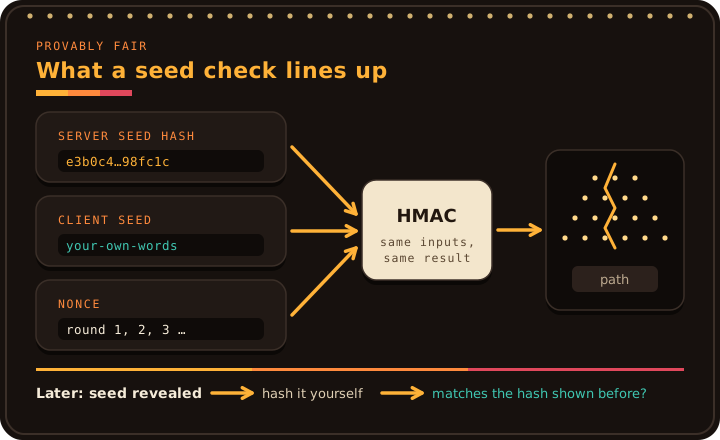
Server seed. A random value created by the game operator. You see only its hash — a one-way fingerprint — while the seed is in use.
Client seed. A value on your side. The game usually fills one in, and you can replace it with your own text.
Nonce. A counter that goes up by one with each drop, so the same pair of seeds never produces the same result twice.
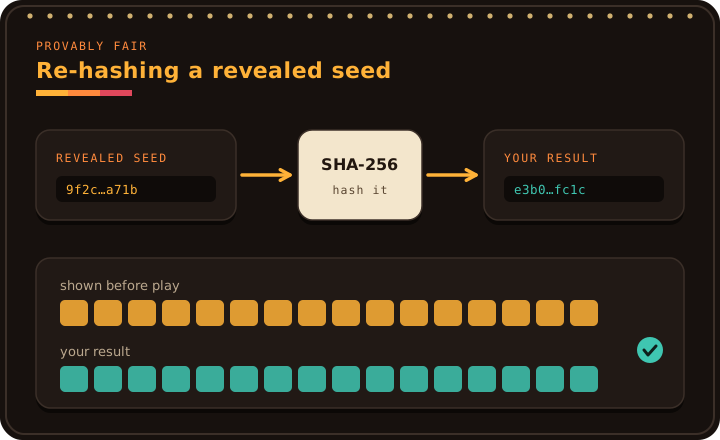
Reveal. When you rotate to a new server seed, the old one is shown in full. Hash it yourself and it must match the fingerprint you saw earlier.
Because the fingerprint was on screen before your first drop, the operator cannot swap the server seed afterwards without the hashes failing to match. And because you supplied the client seed, the operator could not have picked a server seed that suits a value it did not know. The same kind of check-before-trust habit carries over to the account itself, which is what the plinko casino sites page scores through licence entries and identity clauses rather than seeds.
Where the seed panel sits in a casino game
The panel is rarely on the main board. Look in these places, in this order:
The check has two moments. Before play you see only the hash of the server seed; after the seed is rotated you get the seed itself, hash it yourself, and then replay any round from the three inputs.
A shield, padlock or «fair» icon in a corner of the game window.
The settings or gear menu next to the stake field.
The round history: clicking a past drop often opens its seeds, nonce and result.
The casino's help or fairness page, for a house version of the game.
Not every Plinko is seed-based. Some studio titles run on a random number generator tested by an outside lab and show no seed panel at all. That is a different model, not a hidden one, and the rules panel usually says which kind you have. The house originals and studio titles guide explains how to tell the two apart in a lobby.
Verify one drop: a practical checklist
Before you play
Open the seed panel and copy the hashed server seed into a note, together with the date.
Replace the client seed with a text of your own, and copy that too.
Note the current nonce. It is often 0 or 1 on a fresh pair.
During play
Play the drops you intended. For the one you want to check, write down its nonce, the row count, the risk setting, the landing slot and the multiplier shown.
If the history panel lists these for you, take a screenshot instead.
After rotation
Rotate the server seed from the same panel. The previous seed now appears unhashed.
Hash the revealed seed with the function the game names and compare it with the fingerprint in your note. They must be identical, character for character.
Enter three things into a verifier: the seed that was just uncovered, the client text you chose, and the nonce of that drop. Many games offer one in the same panel; any tool that follows the game's published method will do.
Confirm the recomputed landing slot matches the one you wrote down.
If the hashes differ, or the recomputed slot does not match, save the screenshots and raise it with the casino's support in writing.
From hash to a landing slot
The combined seeds and nonce produce a long hash. The game turns that hash into a sequence of left or right turns, one per row, and the count of right turns gives the slot. The exact conversion differs between implementations, which is why a verifier has to follow the method the game itself documents rather than a generic one.
Notice what is not an input: the paytable. The seeds decide the path, and the path decides the slot. The multiplier printed under that slot comes from the paytable you selected. Change the risk level and the same seeds would drop the ball into the same slot and simply pay a different figure. The rows and risk panel explained covers that split in more detail.
What provably fair plinko does not cover
A matching hash proves one narrow thing: the drop was not changed after the fact. It says nothing about the following, all of which matter more to your balance.
The one step anyone can run without trusting the casino: hash the seed it reveals and compare the result with the hash it showed before the rounds were played.
The return figure. A game can be perfectly verifiable and still keep a large share over time. That figure sits in the rules panel or the studio's game page.
The paytable itself. Seeds do not tell you whether the edge figure is generous or thin; the multipliers walk-through helps with that.
Maximum bet and maximum win lines in the game rules or casino terms.
Account rules. When documents can be requested, how long you have to send them, and what the casino can do with a balance in the meantime — see when ID checks can start.
Withdrawal caps and instalments, which decide how a large landing leaves the account.
A casino can show a flawless seed panel and still have terms that hold a withdrawal for documents. Check both.
Seed habits that make checking easier
A few small routines turn verification from a chore into a habit.
Set a client seed you will recognise, such as a date and a word, so a copied value is easy to spot.
Rotate the server seed at the end of every session rather than letting one pair run for weeks; a shorter pair means fewer nonces to scroll through.
Keep one note per session with the hashed seed, the client seed, the first and last nonce and the casino's name.
Check a drop you care about, such as a large landing, and one ordinary drop picked at random. Checking only the big ones tells you less.
Signs worth a second look
No hash is visible before play, only after.
The client seed cannot be changed.
Rotation is missing, so an old server seed is never revealed.
The verifier asks for your account login rather than just seeds and a nonce.
None of these proves a result was altered, but each removes part of what makes the check meaningful.
Questions people actually type
Does provably fair plinko mean the game pays back more?
No. The seed check confirms that a drop was fixed in advance and not edited afterwards. How much the game returns over time comes from its paytable and is stated, where the game prints it, in the rules panel or on the studio's page. A verifiable game and a generous game are two separate questions, and each needs its own look.
Can I check a drop without rotating the server seed?
Not fully. While a server seed is active you only see its hash, so you cannot recompute any result from that pair yet. Rotating reveals the old seed, after which every drop played on it can be checked. Some players rotate after each short session for exactly this reason; it costs nothing and closes the pair for good.
What should I do if a recomputed drop does not match?
First repeat the steps: a wrong nonce or a client seed copied with a stray space causes most mismatches. If it still fails, keep the hashed seed note, the revealed seed, the nonce and screenshots of the drop, and send them to the casino's support in writing so there is a dated record of the question and the answer.