How we order Plinko casinos: a lobby visit, five checks, one register
A card needs two things before it gets a number: a Plinko tile seen on the casino's own pages, and terms that can be held against five plain checks. Here is each step, with a real clause for every point.
This page explains how we order Plinko casinos, step by step, so you can repeat any part of it on your own screen. Nothing here depends on a feeling about a brand. Each point on a card traces back to a line on the casino's own pages or an entry in a licence register, with the date it was seen.
Step one: the lobby visit
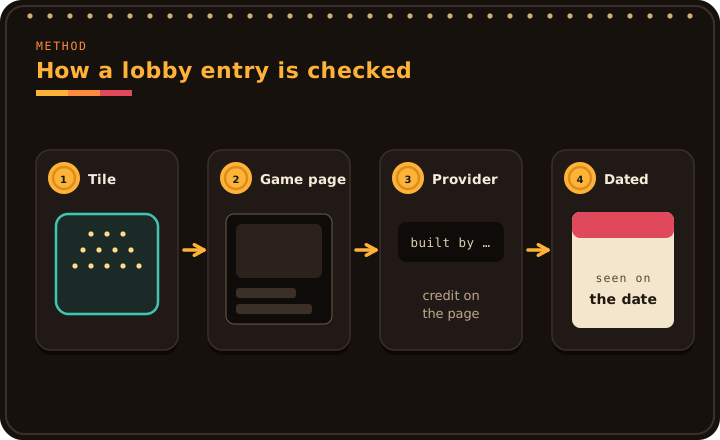
A casino enters the deck only if Plinko shows up on its own pages. On 16 September 2026 every lobby was opened in an ordinary browser, and a sighting counted in three forms:
a lobby tile carrying a Plinko title, such as the PLINKO tile in the Sportsbet.io Originals row;
a game page for a Plinko title, such as Winna's page crediting Winna Originals;
a provider page on the casino's own site listing the title, such as the Spribe page at Bitcasino.io.
The studio is written down as the casino prints it. Where the tile or page names no studio, the card says so and treats the game as a house version; Rocketpot's Plinko, filed under Exclusive Games, is one case. A game address that sits in a sitemap file without a visible tile or page does not count as a sighting. That house-or-studio split for every casino, along with its licence and withdrawal cap, is what the plinko casino sites listing sorts into a single deck.
Figures a casino prints about a studio's game stay with the casino. Blockbet shows 97.00% RTP for SmartSoft's Plinko X Classic, while SmartSoft's own page for that title shows no figure; the card keeps the two apart. The guide to house originals and studio titles explains how to make the same distinction yourself.
How we order Plinko casinos: the five checks
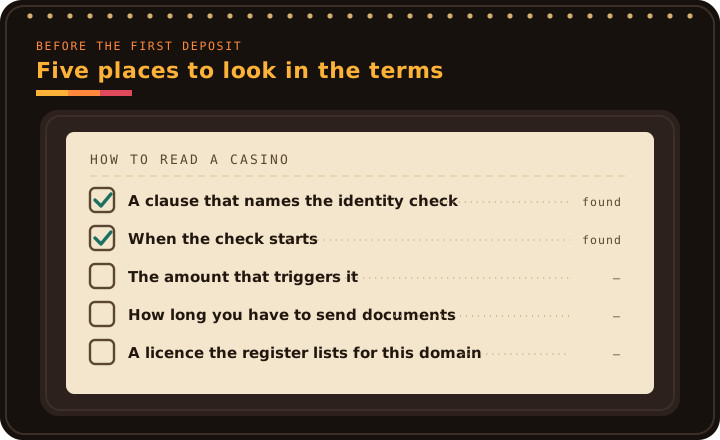
A casino with a sighting then goes through five checks, one point each, all taken from its terms and from the register of the authority named for its licence.
A title is only listed after all four steps: the tile, the game’s own page, the credit naming who built it, and the date on which it was seen.
1. An ID clause is printed
The terms must say that identity documents can be requested. All twelve numbered casinos do. For Bitsler this is the only point the terms earn: cl. 8.22 and cl. 4.3 allow a request, and nothing more is attached.
2. The clause names a moment
The clause must say when a check begins. Rocketpot ties it to withdrawal (cl. 11.4, 12.4); Metaspins ties it to a trigger event (cl. 9.7). Both earn the point. Bitsler does not, because its clause gives no moment at all.
3. A sum is printed
A figure in the clause earns the point, because it tells a player roughly where a request becomes likely. Bitcasino.io names €2,500 or its value in coins. Winz.io and Metaspins print no amount, so the point stays empty.
4. A deadline for documents is set
The terms must give a period for sending documents. Rainbet allows 72 hours under cl. 20.1, and Metaspins 30 days under cl. 9.10. Bitcasino.io and Sportsbet.io set no deadline, which costs each of them this point.
5. The register lists the licence under the casino's own domain
The licence must appear in the issuing authority's register with the casino's own domain attached. Sportsbet.io passes: its Curaçao entry came up active for sportsbet.io on 16 September 2026. Vave does not: its certificate, OGL/2024/1676/0905, listed vavegame.com and not vave.com when looked up on 12 September 2026. Winna misses for a different reason, since the Tobique holder list names companies and shows no domains.
Each licence was searched by number and, where the register allows it, by domain. The Curaçao certificate portal (cert.cga.cw) shows the holder, the certificate number, its status and the domains attached. The Anjouan register shows holder, number, domains and an expiry date. The Tobique holder list prints company names and dates only.
Lookups ran between 8 and 16 September 2026, and each card carries its own date. A lookup can also expose a gap. Hyper Lucky's Anjouan entry lists hyperlucky.com and still reads valid, but its expiry date of 28 August 2026 had already passed on 16 September 2026, so the card does not take the point. Rocketpot's terms quote 1668/JAZ, which the Curaçao portal returned as not valid on 12 and 13 September 2026.
Studio sheets
What a studio says about its own Plinko comes from the studio's own game page, read on 16 September 2026. Spribe prints an RTP of 97%. BGaming prints 99%, high, normal and low risk, 8 to 16 lines and a top multiplier of 1,000×. Hacksaw Gaming prints seven RTP versions from 98.98% to 88.20%, low, medium and high risk, 8 to 16 rows and a top win of 3,843.3×. SmartSoft and TaDa Gaming print none of these values. The rows and risk comparison places those sheets next to each other.
What stays outside how we order Plinko casinos
The score measures what the terms and the register say about identity checks and licences. Several things a player may care about sit outside it:
The five checks the cards on this site count, written as a card you could hold next to the terms. A blank on the card means the clause was not found, not that the answer is “no”.
how many Plinko titles a lobby holds;
the size of a welcome bonus;
speed of any kind, including support replies;
which studio made the game;
withdrawal caps and coin lists, which appear on the cards but earn no points.
Casinos with the same score keep the order of the listing. None of these items moves a card up or down, however attractive it looks in a lobby banner, and none of them can make up for a missing clause. The Vave card at the top of the deck carries no number.
The two real-money tests
Everything on the cards comes from reading pages and registers, apart from two accounts where money actually moved.
The Vave account ran on 28 August 2026, with the editors putting in and taking out their own funds. Withdrawals totalling about 5,000 USDT went through without any request for ID. That is one account over one period, and cl. 8.7 of Vave's terms still allows a request before any payout.
The TrustDice account ran through May 2026, fed with USDT deposits spread over several weeks. Withdrawals passed without verification until the running total went beyond about US$5,000; the next one was held as payment under review. A compliance email then brought a Veriff link. A driving licence was refused first; a passport got through at attempt number five. Later still, a further email from TrustDice wanted documents once again.
Neither result changes a score, and neither is a promise about how the next account at either casino will be treated. They are here because they show where real accounts meet the scored terms: the terms set the frame, and a single account only shows one path through it. The page on ID clauses and document requests sets them beside the terms.
A dash for an empty field
When a casino's terms or a studio's page give no value for a field, the card shows a dash: «—». A dash is not a zero, a guess or a figure borrowed from somewhere else. Sportsbet.io's withdrawal cap and Hyper Lucky's coin list both show one, as do the RTP, rows and top win for TaDa Gaming's Plinko.
Questions people actually type
Why does a casino with several Plinko titles sit below one with a single house game?
Because the number of titles earns nothing. The order comes from the five checks on identity clauses and register entries. A lobby with three studios can still miss a deadline or a domain match in the register, while a lobby with one house Plinko can pass four checks. The cards show both the games and the score, so you can weigh them yourself.
Does a point for the register mean the casino is safe?
No. The point only says the issuing authority lists that licence under the casino's own domain on the date of the lookup. It says nothing about game fairness, support or how a dispute would go. Treat it as one line of evidence, and look the entry up again yourself on the day you sign up, since entries change.
Why is a sighting in a sitemap file not enough?
A sitemap lists addresses, not games a player can open. A title can sit there long after its tile has left the lobby, or before it arrives. A card is only numbered when the Plinko could be seen as a tile, a game page or a provider listing on the casino's own site, so the card describes something you can actually find.