Plinko multipliers in a casino game: reading the row of numbers under the pegs
The strip of figures along the bottom of a Plinko board is the whole price list of the game. Here is how to read it in a lobby, what changes it, and what a top figure means once a casino's terms get involved.
Open a Plinko game from any casino lobby and, before the first drop, look at the bottom edge of the board. Each slot carries a figure followed by the × sign. Those plinko multipliers are what a landing pays against your stake, and together they form the full price list of the game. Reading that strip carefully takes a minute and tells you more about the next session than any colour or animation on the screen.
How plinko multipliers turn into money
A multiplier applies to the stake of that one drop. Land on 2× with a US$1 bet and the balance gets US$2 back, a gain of US$1. Land on 0.5× and it gets US$0.50 back, a loss of half the stake. Anything under 1× is a partial refund rather than a win, even when the game lights it up and plays a sound.
That last point is worth fixing in memory. On most paytables several central slots sit below 1×, and those are the slots the ball visits most. A session full of cheerful landings can still leave the balance lower than it started. That same swing between rare big numbers and steady small returns is what separates one lobby from the next across the plinko casino sites comparison, alongside each entry's licence and withdrawal cap.
Reading the strip, slot by slot
Work from the centre outwards.
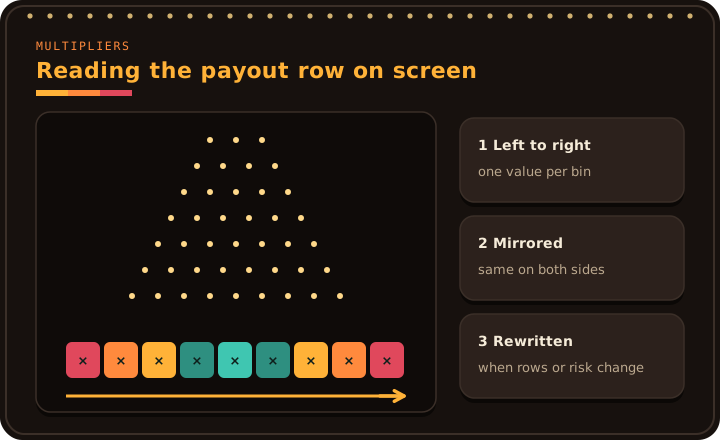
The row under the board is the only part of the round printed in advance. Read it before the first drop, and read it again after touching the rows or risk settings.
Centre slot or slots. The most common landing. Note whether it prints under 1×, and by how much.
The first figure at or above 1×. How far from the centre it sits tells you how many landings in a row are partial refunds.
The step before the edge. Often modest compared with the corner.
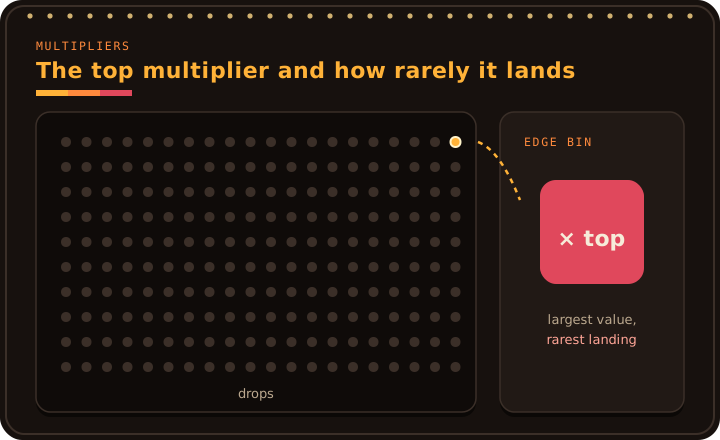
The edge slot. The largest figure, and the rarest landing. The edge slot explainer has the path counts.
Then check the two halves match. A normal board is symmetric, so the left and right strips print the same figures in reverse order.
A made-up strip to practise on
Imagine a 12-row board printing, from the edge inwards: 33×, 11×, 4×, 2×, 1.1×, 0.6×, 0.3×, with the 0.3× in the centre and the same figures repeated on the other side. These are illustration values, not any real game. On that example strip five slots on each side pay back more than the stake, the centre and its two neighbours do not, and the centre returns less than a third of it.
What changes the plinko multipliers on your screen
Two controls rewrite the strip, and both are usually next to the stake field.
Rows. More rows mean more slots, a larger figure at each edge and rarer edge landings.
Risk. A higher risk setting loads a different paytable for the same board: corners go up, the centre goes down. The ball's path does not change.
Every time you touch either control, read the strip again. A figure you noticed on 8 rows is not there on 16, and a centre that paid 1× on low risk may pay far less on high. The panel settings guide walks through the two controls together.
Where a top figure is printed outside the board
The board shows the paytable for the current setting only. To see the highest figure a game offers across all settings, look in three places.
The rules or info panel inside the game, which often lists each row and risk combination.
The studio's own page for the game, for a studio title.
The casino's game description, for a house version built by the casino itself.
If none of these prints a top figure, do not assume one from another game with the same name. Different studios build different paytables, and even two casinos can show different settings for what looks like the same title.
Studio sheets: the return, risk settings, row range and top multiplier each studio prints on its own Plinko page. A dash is a figure that page leaves out.
The sheets above carry only what each studio prints on its own game page, dated 16 September 2026. Two of them give a top figure. BGaming's page for its Plinko prints a maximum multiplier of 1,000×, on a board of 8 to 16 lines with three risk levels it calls high, normal and low. Hacksaw Gaming prints a max win of 3,843.3× for its Plinko, with 8 to 16 rows and risk set to low, medium or high.
The headline number belongs to one edge bin, and that bin is reached by a sliver of drops. The dot grid is a picture of rarity, not a count from any game.
Spribe's Plinko page prints a return figure but no top multiplier, so the sheet leaves that field as «—». The same goes for any other empty field: the rules panel of the game you open is the place to look, not a number from a different studio.
In a lobby, this matters because tiles called Plinko from different studios sit side by side. A 1,000× ceiling and a 3,843.3× ceiling are very different corners, and the tile credit tells you which one you are looking at.
What the history panel shows about your own landings
The paytable tells you what each slot pays; the round history tells you where your drops actually went. Most Plinko games keep a strip or a list of recent landings with the multiplier each one paid, and many let you open a single drop for its stake, setting and result.
After fifty or a hundred drops, scroll through that list. It usually looks dull: a long run of central figures under 1×, a scattering of small gains and, perhaps, one landing further out. That picture is the paytable at work, and it is a better guide to your next stake size than the one large figure you remember.
Changing settings halfway through
The history records the setting of each drop, so a list that mixes 8-row low-risk drops with 16-row high-risk ones cannot be read as one sample. If you switch, note the drop at which you did, and judge each part on its own strip.
A top figure is not a top payout
A large edge figure multiplies the stake of one drop. What you can actually take out of the casino is decided by other lines, and they are worth reading before raising the bet.
Maximum bet per drop in the rules panel caps what the multiplier can be applied to.
Maximum win per round or per bet, where the game rules or the casino terms print one.
Withdrawal caps per day, week or month in the casino terms, and whether big sums are split into instalments.
Vave's terms are one worked case: cl. 8.8 (25 August 2026) sets no cap per period, but a win from 50,000 USDT may, exceptionally, be paid in equal instalments. Other casinos print fixed ceilings per week or per month, which the withdrawal caps overview compares clause by clause.
A two-minute paytable check
Note the row and risk setting currently selected.
Read the centre figure and count the slots below 1× on each side.
Read the edge figure for this setting.
Open the rules panel and look for a list of all settings and a max-win line.
Decide the stake with the centre in mind, not the edge — the centre is where most drops end.
If you want to confirm a drop landed where the game says, use the seed check steps.
Questions people actually type
Why do some plinko multipliers show less than 1×?
Because the central slots are where most drops land, and a game that paid the full stake or more there would give away money on its most common result. A figure such as 0.5× returns half the stake. It is a partial refund, not a win, even when the board celebrates it. Counting the slots under 1× is the quickest way to judge how a setting will feel.
Is the highest multiplier the same at every casino?
Not necessarily. The figure belongs to the game and its setting, and different studios build different paytables for titles that share the Plinko name. A house version made by the casino itself has its own strip again. Read the rules panel of the exact game you open rather than relying on a figure seen in another lobby.
If I land the top figure, is the whole amount paid out at once?
That depends on the casino's terms, not the game. Check for a maximum bet, a maximum win per round and a withdrawal cap per period. Some terms also allow large wins to be paid in instalments; Vave's cl. 8.8, for example, allows equal instalments for a win from 50,000 USDT. Read those lines before raising the stake.